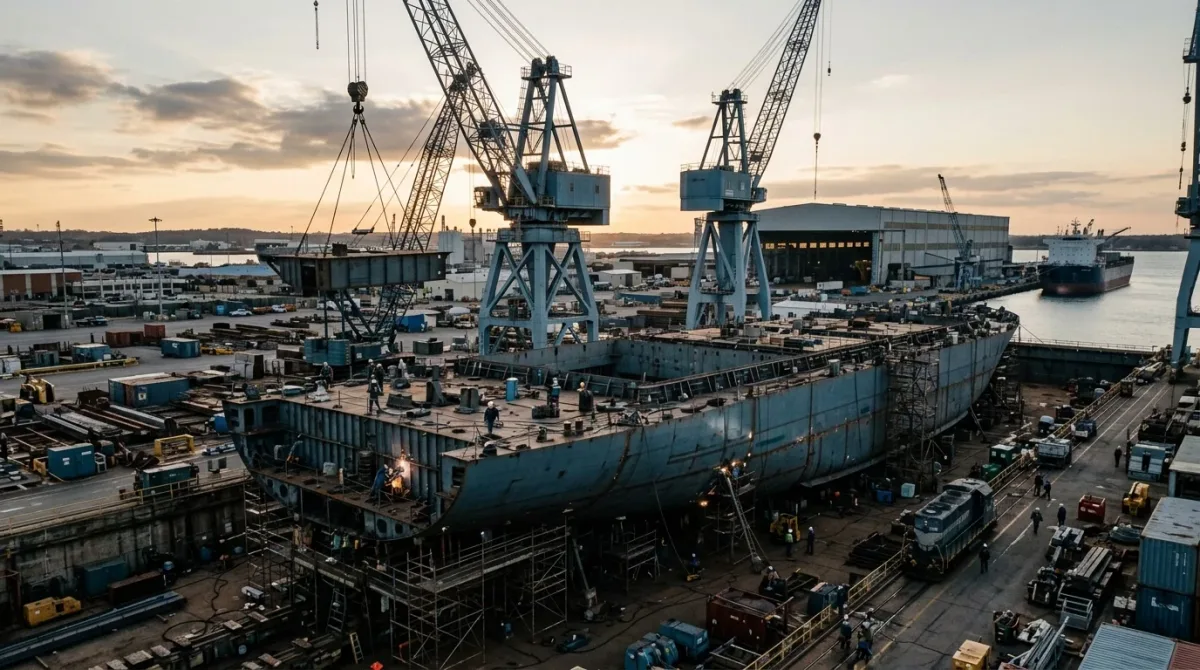
The Jones Act is the common name for Section 27 of the Merchant Marine Act of 1920, codified at 46 U.S.C. § 55102, which requires that any vessel carrying merchandise between two U.S. points be built in the United States, owned by U.S. citizens, and issued a coastwise endorsement by the U.S. Coast Guard, according to the Maritime Administration's domestic shipping guidance, current as of its March 17, 2026, waiver notice.
What does the Jones Act require?
The Maritime Administration, an agency of the U.S. Department of Transportation, states that a vessel must satisfy three conditions to move cargo between domestic points: it must be built in the United States, it must be owned by U.S. citizens, and it must hold a coastwise endorsement certifying eligibility issued by the Coast Guard. A vessel lacking any one of the three cannot legally carry merchandise from one U.S. port to another. Violations fall under the enforcement authority of U.S. Customs and Border Protection, which the Maritime Administration identifies as operating through its Jones Act Division of Enforcement, known as JADE.
How does the law connect to naval shipbuilding?
The Jones Act does not govern warship construction directly, but the shipyards, suppliers, and mariner workforce it sustains are the same industrial base the Navy draws on for auxiliary and support vessels, and its health has become a recurring subject of federal policy attention. President Donald Trump signed a maritime executive order on April 9, 2025, directing a government-wide review of the commercial maritime sector, according to an April 10, 2025, report by news.usni.org. The order assigned a shipbuilding evaluation covering Army, Navy, and Coast Guard procurement, across surface, subsurface, and unmanned platforms, due to the president within 45 days, and required a broader maritime action plan from the Departments of Defense, Commerce, State, Transportation, Homeland Security, and Labor, along with the U.S. Trade Representative, by that November.
The same report cited data from BRS Shipbrokers showing Chinese shipyards took 3,419 orders in 2024, up from 1,216 in 2020, a share the report described as more than half of global orders that year — figures the order's backers pointed to as evidence of an eroding U.S. shipbuilding position relative to China's.
Can the Jones Act be waived, and by whom?
The Maritime Administration states that the Secretary of Homeland Security holds waiver authority under 46 U.S.C. § 501, which can be exercised when doing so is deemed necessary in the interest of national defense. Before a waiver is granted, the Maritime Administrator must first determine that no coastwise-qualified vessels are available to meet the defense-related need. The agency's published record of waiver determinations includes actions dated May 12, 2021; May 13, 2021; September 28, 2022; October 16, 2022; and March 17, 2026, the most recent listed as of this writing.
What reform proposals are in circulation?
Legislative efforts to address shipbuilding capacity without repealing the law have advanced in Congress. A bipartisan measure known as the Ships for America Act, led by Sen. Mark Kelly (D-Ariz.) and then-Rep. Mike Waltz (R-Fla.), was described in a Sept. 25, 2024, USNI News report as a roughly 200-page bill that had drawn more than 200 congressional co-sponsors ahead of its planned introduction after that November's election. The bill's stated goals include cargo-preference and tax-credit incentives to make U.S.-flagged vessel operation more cost-effective, workforce recruitment and training support for shipyards, additional training ships for state maritime academies, and alignment of U.S. and international mariner licensing rules.
The same report quoted Kelly saying of the Jones Act, "we're not suggesting repeal," framing the bill as an effort to improve the law's cost-effectiveness rather than eliminate it. The report also cited figures placing U.S. annual output at five ships from 20 shipyards, compared with roughly 1,500 ships a year from Chinese yards and a 50-ship order backlog at South Korea's Hyundai, alongside an estimate that China operates about 5,500 merchant ships, close to half the global total.
The three-part test, summarized
- Built in the United States — the vessel's hull and superstructure must be of domestic construction.
- Owned by U.S. citizens — ownership must meet U.S. citizenship requirements set by the Maritime Administration.
- Coastwise-endorsed — the vessel must hold a Coast Guard-issued coastwise endorsement certifying its eligibility for domestic trade.
Each condition is independently necessary; the Maritime Administration's guidance does not describe any substitute path to coastwise eligibility for a vessel missing one of the three.
Why the Navy has a stake in this debate
Naval shipbuilding and commercial shipbuilding largely share the same physical infrastructure — the same shipyards, welders, pipefitters, and steel suppliers that build Jones Act-qualified tankers and container ships also compete for Navy auxiliary, sealift, and support-vessel contracts. A shipyard base sized to a shrinking commercial order book has less surge capacity available if naval construction schedules slip or wartime sealift demand rises, which is the industrial-base logic that both the April 2025 executive order and the Ships for America Act invoke in their stated rationale, according to the cited USNI News reports. Neither measure proposes repealing the Jones Act itself; both instead target the incentives, workforce pipeline, and shipyard capacity surrounding it. Readers should treat each bill's provisions as proposed policy rather than enacted law unless a subsequent official action confirms passage.
For a related business news perspective, read How Fixed-Price Incentive Contracts Shape Navy Shipbuilding.