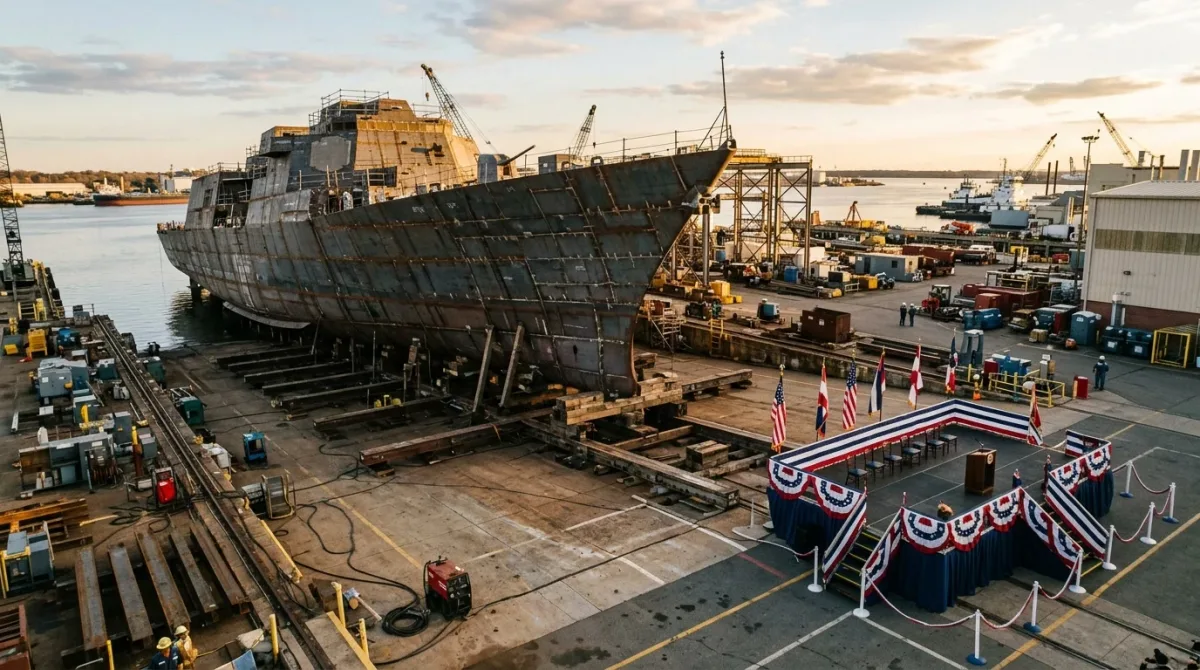
A U.S. Navy warship becomes a commissioned vessel through four sequenced, publicly documented milestones — keel laying, launching, christening, and commissioning — a process in which the interval between launching and commissioning alone can span three weeks to three years, according to the Naval History and Heritage Command's reference page on the subject, accessed August 20, 2026.
What Are the Four Milestones in Building a Navy Ship?
Every U.S. Navy ship passes through the same four ceremonial and technical stages before it joins the fleet, according to the Naval History and Heritage Command (NHHC). Each milestone marks a distinct construction phase rather than a single administrative step.
- Keel laying — the shipyard formally begins fabrication, traditionally marked by authenticating the keel with the initials of the ship's sponsor, per NHHC.
- Launching — the physical movement of the hull from the building way into the water, per NHHC.
- Christening — the ceremonial naming of the ship, performed by a sponsor who declares, "In the name of the United States I christen thee [ship name]," per NHHC's reference page.
- Commissioning — the hull is placed in active service as a Navy command, following installation of engineering systems, weapons, and electronics and the training of the crew, per NHHC.
What Happens During Keel Laying?
Keel laying marks the start of a ship's physical construction and is typically held at the building shipyard with the ship's sponsor present. The Naval Sea Systems Command documented one recent example: the keel laying of the future USS Constellation (FFG 62), lead ship of the Constellation-class guided-missile frigate program, at Fincantieri Marinette Marine in Marinette, Wisconsin, on April 12, 2024, according to a Naval Sea Systems Command article dated the same day. The Naval Sea Systems Command describes a keel laying as an event that "signifies the formal beginning" of a ship's construction, per the same article.
The ceremony is largely symbolic in modern construction, since large sections of a ship's hull are often fabricated and joined before the formal keel-laying event, but it remains the Navy's recognized start-of-construction milestone for public and legislative tracking of a shipbuilding program's schedule, as reflected in the Naval Sea Systems Command's practice of issuing a dedicated release for the event.
What Happens During Christening and Launching?
Christening and launching are distinct acts that are frequently combined into a single public ceremony. Christening is the formal naming of the ship, performed by a sponsor — traditionally a woman of prominence connected to the ship's namesake or mission — who breaks a bottle against the bow, according to the Naval History and Heritage Command's history of the practice.
Launching is the separate physical event of moving the hull from the building way into the water, which NHHC describes as the vessel's transition into its operational environment. NHHC traces female ship sponsors to an unnamed woman who christened the sloop-of-war Concord in 1828, with Lavinia Fanning Watson recorded as the first identified female sponsor, in 1846. Before that shift, NHHC records Captain James Sever standing as sponsor of the frigate Constitution in 1797, and notes that wine, whiskey, water, and other liquids were used historically before champagne became the predominant christening fluid later in the 1800s.
What Happens at Commissioning?
Commissioning is the ceremony that formally places a completed ship in active naval service. According to an NHHC ship-commissioning infographic, the sequence runs through fixed stages: remarks from flag officers and distinguished guests, the hoisting of colors, and the moment the commissioning pennant breaks at the masthead — the point at which, per NHHC, the ship becomes "a Navy command in her own right."
The commanding officer then reads the appointment orders and assumes command, and the executive officer sets the first watch. The ceremony traditionally closes when the ship's sponsor gives the order "Man our ship and bring her to life!", after which the crew mans the rails, according to the same NHHC infographic. NHHC also documents that the modern commissioning-pennant custom dates to a legend from the Anglo-Dutch naval conflicts of 1652 to 1654, and that Secretary of the Navy Gideon Welles first formally documented commissioning ceremonies in official correspondence in 1863.
How Long Does the Process Take, and Who Is Involved?
The interval between launching and commissioning is not fixed. NHHC states that this preparation period — during which engineering systems, weapons, and electronics are installed and the crew trains — ranges from approximately three weeks to three years, depending on the vessel's complexity, without attributing a specific duration to any single ship class.
Crew members who serve aboard a ship from her commissioning are recorded as "plank owners," a designation NHHC's commissioning infographic describes as recognizing their role in "bringing the vessel to life as a U.S. Navy warship." A prospective commanding officer, the officer designated to take command once the ship is placed in service, traditionally hosts the commissioning ceremony, per the same source.
For a related shipbuilding perspective, read How A Navy Warship Moves From Keel To Commissioning.
For more context, read Primer: How a Navy Ship Moves From Keel to Commissioning.