A fixed-price incentive (FPI) contract sets a target cost and target profit for a shipbuilder, then shares any cost overrun or underrun between the builder and the Navy up to a ceiling price, after which the builder absorbs the remainder. More than 80 percent of Navy shipbuilding contracts awarded in the decade before 2017 used this structure, according to a March 2017 report by the Government Accountability Office (GAO-17-211). The arrangement is meant to give shipbuilders a financial incentive to control costs while capping the government's exposure once spending passes an agreed ceiling.
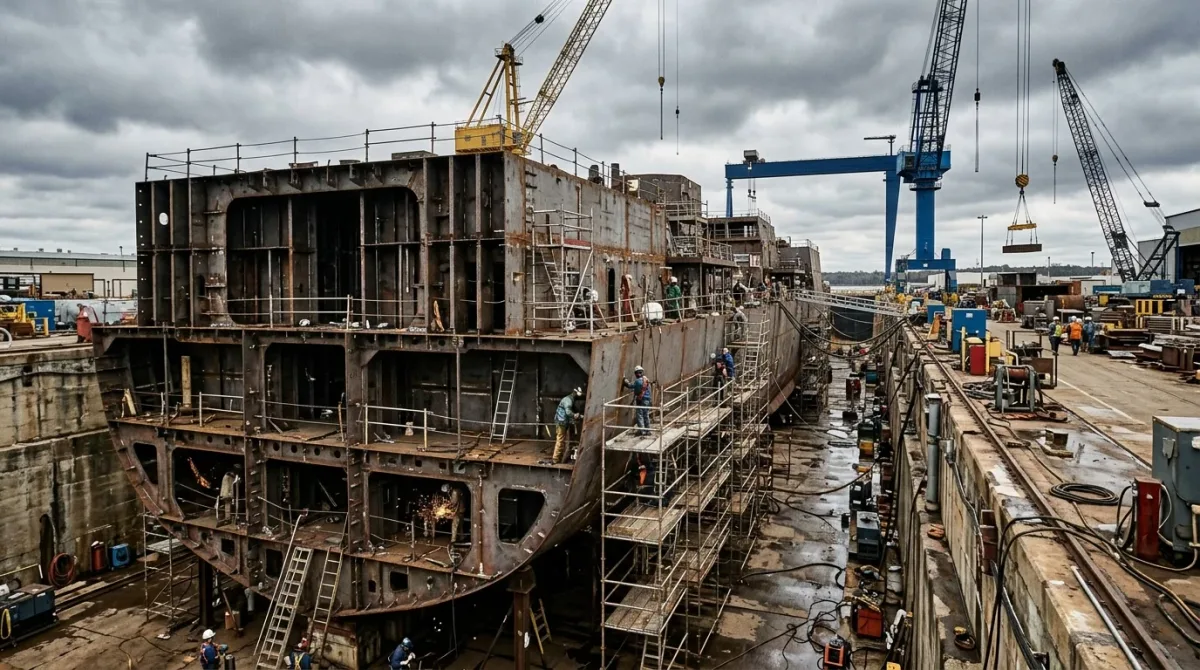
The U.S. Navy's current Constellation (FFG-62) class frigate program, built by Fincantieri Marinette Marine in Marinette, Wisconsin, illustrates how the contract type functions in practice, and where oversight bodies say it has fallen short. The class has run into design and schedule problems since construction began, according to GAO and the Congressional Research Service (CRS), as documented in USNI News's March 6, 2025, report to Congress.
What is a fixed-price incentive contract?
Under an FPI contract, the Navy and the shipbuilder negotiate a target cost, a target profit, and a ceiling price before work begins. If the ship costs less than the target, the builder keeps a larger share of the savings as profit. If it costs more, the builder's profit shrinks according to a pre-set sharing ratio, commonly split evenly between government and contractor up to a defined ceiling, per Department of Defense guidance cited in the GAO's March 2017 report (GAO-17-211).
Once actual costs exceed the ceiling price, the shipbuilder is contractually responsible for the remaining overrun, at least in principle. The Navy favors this structure over straight cost-reimbursement contracts because it is intended to transfer some risk to industry rather than leaving the government to absorb all cost growth, according to the same 2017 GAO report.
How well has the incentive structure worked?
The GAO's 2017 review of six Navy shipbuilding contracts found that half lacked documented justification for choosing an FPI structure over alternatives, and that in most of the contracts examined, the Navy bore a disproportionate share of cost risk rather than the roughly even split called for in department guidance. The report also found the Navy had added more than $700 million in supplemental incentive payments across five contracts, some tied to work shipbuilders were already expected to perform routinely, and that builders could still collect these payments on ships delivered late or over budget. Of 11 ships GAO reviewed as delivered, eight had experienced cost growth, with one exceeding its target cost by roughly 45 percent, and the Navy had not assessed whether the added incentives improved performance (GAO-17-211).
A more recent GAO report, issued March 25, 2025 (GAO-25-108225), found that Navy shipbuilding costs have continued to grow across multiple programs regardless of contract type. The report states that the Navy's shipbuilding budget has nearly doubled over two decades without a corresponding increase in fleet size, noting that "the Navy has no more ships today than when it released its first 30-year shipbuilding plan in 2003." The report cites the Zumwalt-class destroyer DDG 1000, now priced at $10.6 billion per ship, more than seven times its original estimated unit cost, and the Littoral Combat Ship program, which the GAO says consumed tens of billions of dollars more than initially budgeted. As of that March 2025 report, GAO had issued 90 shipbuilding-related recommendations to the Navy since 2015, of which only 30 had been fully or partially addressed.
How does the Constellation-class frigate contract illustrate the problem?
Fincantieri Marinette Marine holds a fixed-price incentive contract, awarded in April 2020, for detail design and construction of up to 10 Constellation-class frigates, according to USNI News's March 6, 2025, summary of a Congressional Research Service report to Congress. As of that report, the Navy had procured six of the ships through fiscal year 2024 and planned to acquire at least 20 in total, with the fiscal year 2025 budget requesting $1.17 billion for the seventh ship.
The lead ship's delivery has slipped substantially. The GAO's March 2025 report found that construction began in August 2022 when the ship's "basic and functional design" was reported as 88 percent complete, a figure later revised down to 70 percent complete as of December 2024. CRS findings cited in the March 2025 USNI News report describe the original April 2026 contract delivery date for the lead ship as "unachievable," pointing to a delay of roughly 36 months. A May 2024 GAO report, quoted in the same USNI News article, concluded that "beginning construction before the design was complete is inconsistent with leading ship design practices."
Why doesn't the fixed-price structure prevent these overruns?
An FPI contract caps a shipbuilder's downside risk only once a ceiling price is reached, and it does nothing to prevent delay-driven cost growth that occurs before construction even begins, such as incomplete design work. The GAO's March 2025 report flags this dynamic directly in the Constellation-class case, warning that design instability created "mounting construction delays" and raised the risk of budget overruns if similar problems recur on the class's later ships, particularly beyond the first 10 vessels covered by the current contract, a concern also raised in the CRS findings reported by USNI News.
Both GAO reports also point to a documentation and enforcement gap rather than a flaw unique to the fixed-price structure itself: the 2017 report found the Navy often could not show why FPI terms were chosen over alternatives, and the 2025 report found most of GAO's own recommendations for tightening shipbuilding oversight, including on contracting practices, remained unaddressed as of that report's publication.
Frequently Asked Questions
Does a fixed-price incentive contract guarantee the Navy won't pay for cost overruns?
No. The shipbuilder shares cost risk with the Navy only up to a negotiated ceiling price, per Department of Defense guidance cited in GAO's March 2017 report. Above that ceiling, the builder is contractually responsible for further overruns, but the Navy has still absorbed significant cost growth on programs like the Zumwalt-class destroyer and Littoral Combat Ship, according to GAO's March 2025 report.
Who builds the Constellation-class frigate?
Fincantieri Marinette Marine, based in Marinette, Wisconsin, holds the Navy's fixed-price incentive contract awarded in April 2020 for detail design and construction of up to 10 ships, as reported by USNI News on March 6, 2025, summarizing a Congressional Research Service report to Congress.
How many Constellation-class frigates has the Navy ordered?
As of the Congressional Research Service findings reported by USNI News on March 6, 2025, the Navy had procured six ships through fiscal year 2024, with the fiscal year 2025 budget requesting funding for a seventh, against a stated program goal of at least 20 ships total.
For a related shipbuilding perspective, read How A Navy Warship Moves From Keel To Commissioning.