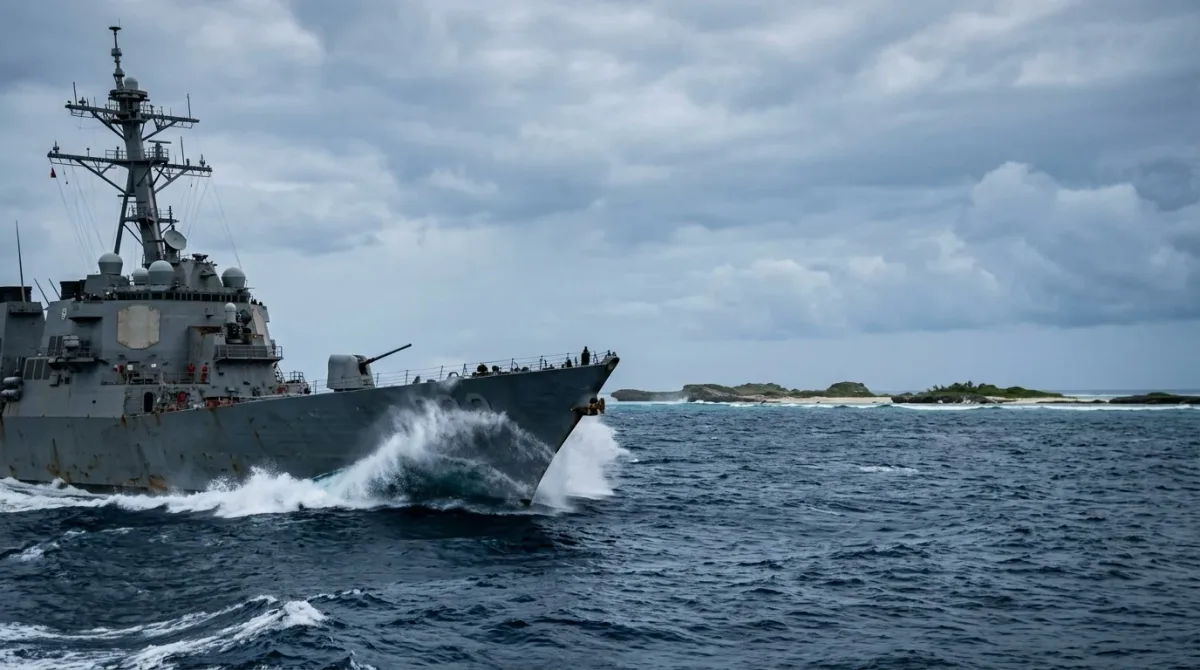
The Freedom of Navigation Program is a Department of Defense initiative, in place since 1979, that uses U.S. military ships and aircraft to contest foreign maritime claims the department judges to exceed international law, according to the department's Freedom of Navigation Program summary dated February 28, 2017. In fiscal year 2020 the program challenged claims by 19 countries, per the department's FY2020 Freedom of Navigation Report.
What is the Freedom of Navigation Program?
The program is a standing Department of Defense effort, directed by successive U.S. presidents beginning in 1979, to preserve global mobility for U.S. military forces by operating against "excessive maritime claims" asserted by coastal states, according to the department's Freedom of Navigation Program summary. The department states the program operates consistent with the balance of interests reflected in the U.S. Oceans Policy adopted in 1983. Operations are conducted by all U.S. military services, not the Navy alone, the summary states.
The department describes operations under the program as "deliberately planned, legally reviewed, properly approved, and conducted with professionalism," per the same summary. The program targets claims regardless of which state asserts them, the document states, including claims by U.S. allies and partners, not only claims made by strategic competitors.
What kind of claims does a Freedom of Navigation Operation challenge?
The Department of Defense's FY2020 Freedom of Navigation Report, covering October 1, 2019, through September 30, 2020, lists several categories of claims the program challenges. These include requirements that foreign military ships obtain prior permission or give advance notification before entering a coastal state's territorial sea, straight baseline claims that extend a state's maritime jurisdiction beyond what the department says international law permits, restrictions on military exercises inside a state's exclusive economic zone, air defense identification zone restrictions applied to aircraft not intending to enter national airspace, and other assertions of security jurisdiction the department deems excessive.
A single claim may be challenged more than once in a given fiscal year, according to the FY2020 report, since the department conducts operations against a claim until the underlying practice changes or the claim is dropped.
How is a single operation planned and conducted?
A Freedom of Navigation Operation, commonly abbreviated FONOP, is executed by a U.S. Navy vessel transiting through or near a disputed maritime feature or zone without seeking the permission the coastal state asserts is required, consistent with the conduct the department describes in its program summary. The operation is framed publicly by the responsible fleet as an assertion of navigational rights under international law, not as a statement on the underlying territorial dispute.
An example is the U.S. 7th Fleet operation conducted by USS Benfold (DDG-65) on September 8, 2021, near Mischief Reef in the Spratly Islands, South China Sea, according to a Navy.mil press release from U.S. 7th Fleet. The release states the operation demonstrated that Mischief Reef, a low-tide elevation in its natural state, is not entitled to a territorial sea under international law, regardless of structures built on the feature.
What did a recent Freedom of Navigation Operation look like?
On December 6, 2024, the guided-missile destroyer USS Preble (DDG-88) conducted a Freedom of Navigation Operation within 12 nautical miles of Swallow Reef in the Spratly Islands, South China Sea, according to USNI News, citing a 7th Fleet statement. The operation challenged requirements imposed by China, Vietnam, and Taiwan that military vessels obtain authorization or give advance notification before transiting the territorial waters each claims around the feature, per the same report.
"The unilateral imposition of any authorization or advance-notification requirement for innocent passage is unlawful," 7th Fleet said in the statement cited by USNI News. The statement added that "unlawful and sweeping maritime claims in the South China Sea pose a serious threat to the freedoms of the seas, including the freedoms of navigation and overflight."
Who conducts and reports on Freedom of Navigation Operations?
Operations are carried out by the service components assigned to the relevant geographic combatant command, most visibly the Navy's numbered fleets such as the U.S. 7th Fleet in the Indo-Pacific, based on the operations documented in Navy.mil and USNI News reporting cited above. The Department of Defense compiles operations into an annual Freedom of Navigation Report; the FY2020 edition, covering fiscal year 2020, is the department's most recently confirmed annual accounting reviewed for this article, and the department states it does not disclose every operational detail in the interest of operational security.
| Category of excessive claim | Description, per the DoD FY2020 Freedom of Navigation Report |
|---|---|
| Prior permission / notification | Requires a foreign military vessel to obtain permission or give advance notice before entering a state's territorial sea |
| Straight baseline claims | Draws maritime boundary baselines that extend jurisdiction beyond what the department states international law allows |
| Exclusive economic zone restrictions | Restricts military exercises or activities within a state's exclusive economic zone |
| Air Defense Identification Zone (ADIZ) restrictions | Applies identification requirements to aircraft not intending to enter national airspace |
| Security jurisdiction claims | Asserts broader security or law-enforcement authority over a maritime zone than the department recognizes |
How does this fit into broader U.S. naval strategy?
The Department of Defense presents the Freedom of Navigation Program as a legal and operational instrument rather than a policy statement on any specific territorial dispute, according to its program summary. Individual operations, such as the USS Preble transit near Swallow Reef and the USS Benfold transit near Mischief Reef, are documented publicly by the responsible fleet after the fact, with the challenged claim and legal rationale stated by name, based on the Navy.mil and USNI News reporting cited in this guide. Readers tracking a specific claim or region should consult the department's most recent annual Freedom of Navigation Report for the fullest sourced accounting the department has published.
For a related shipbuilding perspective, read How A Navy Warship Moves From Keel To Commissioning.