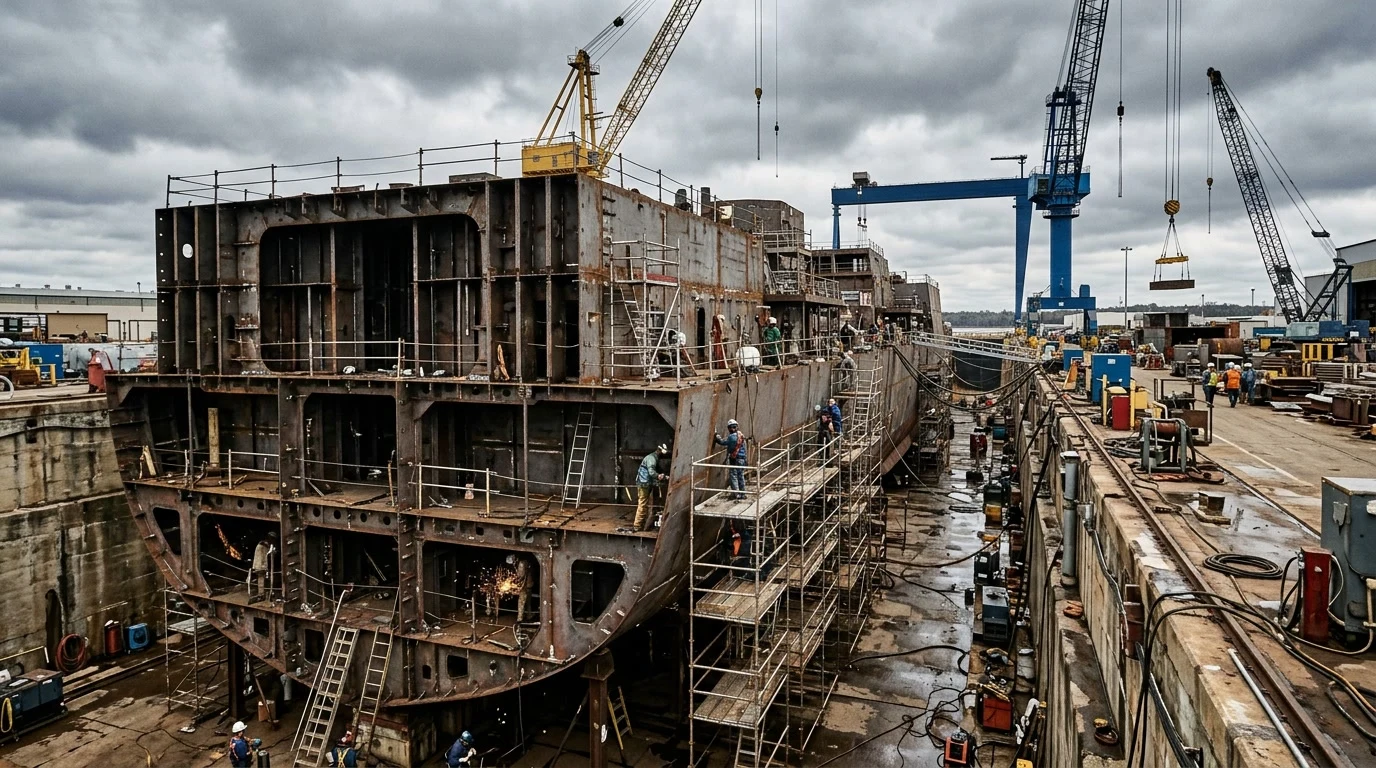
The Government Accountability Office reported on February 27, 2025 that the Navy has invested billions of dollars in private shipbuilders and repair yards over the past decade but still lacks a fully developed strategy for those ship industrial base investments, according to GAO report GAO-25-106286. The report, titled "Shipbuilding and Repair: Navy Needs a Strategic Approach for Private Sector Industrial Base Investments," examined whether the private industrial base can support Navy shipbuilding and repair and how the Defense Department supports it, and found that shipbuilding programs continue to struggle with cost and schedule problems despite the spending.
What did GAO examine?
The review covered the private companies that build Navy vessels and repair surface ships, which GAO identified as key components of the ship industrial base alongside the four public shipyards. Auditors assessed the extent to which the industrial base can absorb the Navy's construction and repair workload and evaluated the support mechanisms the Defense Department uses to sustain it, including facility investments, workforce grants, and contract structures. GAO's conclusion was that the Navy's investment decisions across these tools had accumulated without the strategic framework the office expected, leaving the department unable to demonstrate that its spending targeted the industry's binding constraints.
Why industrial base strategy matters
The private yards build the fleet's new combatants and auxiliaries and share the surface ship repair workload with the public yards, so their capacity sets a hard limit on fleet growth and maintenance throughput. GAO and other analysts have documented persistent delays in ship and submarine maintenance, and prior work found carriers averaging months of late maintenance, costs that accumulate as lost operational days across the fleet. Without a strategy, GAO argued, the Navy risks continuing to fund facilities and suppliers whose expansion does not shorten delivery schedules or reduce maintenance backlogs, while programs miss cost and schedule targets.
What GAO recommended
GAO directed the Navy to develop and document a strategic approach for its private sector industrial base investments, one that links spending decisions to the capacity shortfalls that most constrain shipbuilding and repair outcomes. The recommendation aligned with a series of earlier GAO findings on the same theme, including reports on public shipyard infrastructure and submarine maintenance delays. The Navy generally concurred with the recommendation, consistent with its responses to prior industrial base reviews, and implementation became a trackable item in GAO's open recommendation inventory.
Context for the report
The February 2025 report arrived as Congress prepared to move tens of billions in new shipbuilding money through the fiscal year 2026 budget and reconciliation process, and as the department's Shipyard Infrastructure Optimization Program worked through a 20-year capital plan for the public yards. The intersection of the two efforts makes the recommendation consequential: whatever strategy the Navy develops will shape where the new construction money lands in the private sector, from hull yards on the Gulf Coast to submarine suppliers in New England and the Midwest.