The U.S. Navy's amphibious fleet consists of roughly thirty ships built around four hull types: landing helicopter assault ships (LHA), landing helicopter dock ships (LHD), landing platform dock ships (LPD), and dock landing ships (LSD), according to Naval Vessel Register data as of 2024. The Navy's own force-structure requirement calls for thirty-one amphibious ships, a number confirmed in testimony to Congress, and the fleet has operated just above or below that target for most of the past decade. This guide explains what each class does, how many hulls exist, and where the fleet's aging problem is concentrated.
Why does the Navy need about thirty-one amphibious ships?
The thirty-one-ship requirement comes from Marine Corps lift demands: enough shipping to carry the equipment and aviation element of a Marine Expeditionary Brigade and to surge a Marine Expeditionary Force, according to Navy and Marine Corps statements to Congress. In practice the number matters because the fleet is spread across two coasts and continuous deployments, and each hull spends years in maintenance across a service life. As of 2024 the fleet hovered near thirty hulls, with Navy budget documents from the mid-2020s proposing a path back to the thirty-one requirement through new construction of America-class LHAs and Flight II San Antonio-class LPDs. Commands involved are Commander, Naval Surface Force Atlantic and Pacific, with the ships operating typically alongside Marine expeditionary units as amphibious ready groups.
What are the LHA and LHD big-deck ships?
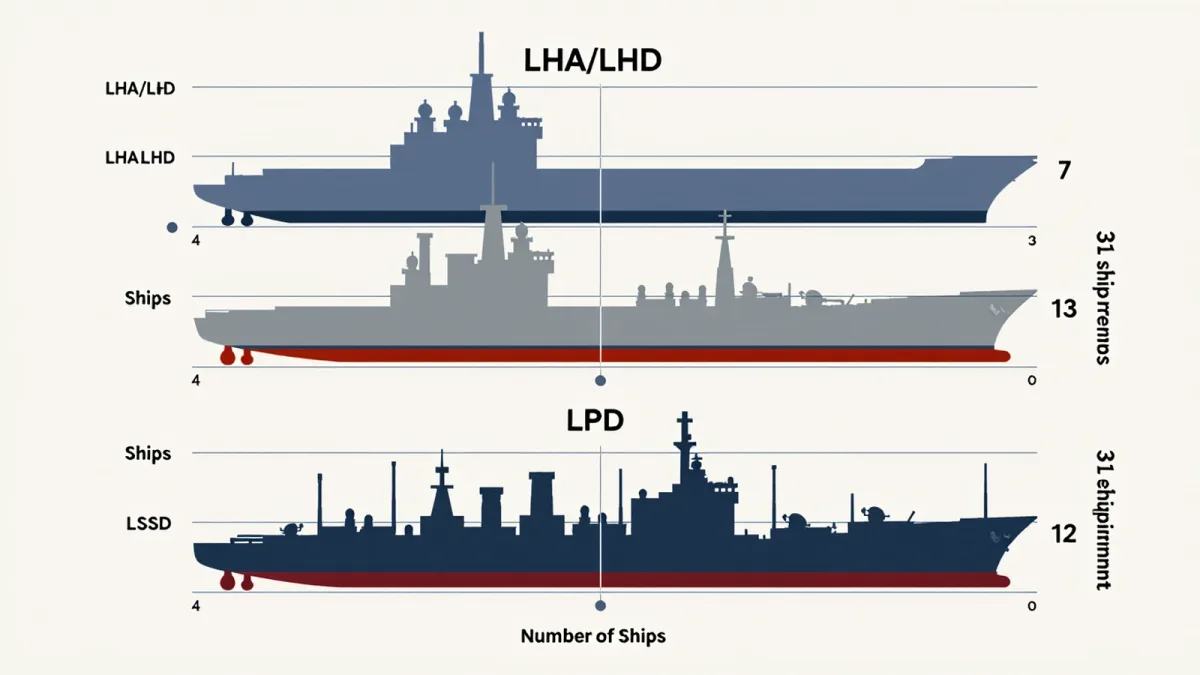
The big-deck amphibious assault ships form the top tier of the fleet: seven hulls as of 2024, comprising two America-class ships (LHA-6 and LHA-7) and five Wasp-class ships (LHD-1 through LHD-5), according to the Naval Vessel Register. These ships displace around 40,000 tons, carry a Marine aviation element of helicopters and F-35B Joint Strike Fighters, and function in the aviation-heavy role. The Wasp class dates from the late 1980s and early 1990s; the America class, beginning with USS America (LHA-6), delivered in 2014, omits a well deck in favor of a larger aviation facility, a design trade documented in Navy program material. A third America-class ship, USS Bougainville (LHA-8), restored a smaller well deck and was in construction at Ingalls Shipbuilding through 2025 for delivery in the middle of the decade. A fourth, LHA-10, was under contract. The big decks are the most demanded ships in the fleet, and their maintenance schedules have shaped amphibious deployment patterns more than any other factor documented in Navy reporting.
What does the LPD San Antonio class do?
The San Antonio class (LPD-17) is the modern backbone of surface connector lift: thirteen ships delivered through LPD-29 as of 2024, according to Navy delivery announcements. Each ship combines a well deck for landing craft air cushion vehicles, a flight deck for helicopters and the V-22 Osprey, and troop and vehicle space for a Marine expeditionary unit's surface element. The class replaced four older ship types at once, including Austin-class LPDs and dock landing ships retired in the 2010s. The final Flight I hull, USS Richard M. McCool Jr. (LPD-29), was delivered in 2024. The Navy has begun procurement of the LPD Flight II variant, which modifies the design at reduced cost, with Ingalls Shipbuilding holding contracts for the first Flight II hulls. The class absorbed well-documented construction and reliability problems in its first decade, but by the mid-2020s the ships had become the standard deployment platform for East and West Coast amphibious ready groups.
Why are the LSD dock landing ships the fleet's problem ships?
Twelve dock landing ships remained in service as of 2024: eight Whidbey Island-class ships (LSD-41 through LSD-48) and four Harpers Ferry-class ships (LSD-49 through LSD-52), according to the Naval Vessel Register. The class entered service between 1985 and 1998 and was originally expected to be replaced by the San Antonio program; the San Antonio class covered most of that mission, and Navy plans in the mid-2020s did not include a one-for-one LSD replacement. These ships carry landing craft in a flooded well deck and support Marine surface lift, but their hulls are the oldest in the amphibious fleet after the Wasp class. Navy budget documents have retired individual LSDs as they reach the end of service life, and the class is the primary reason the amphibious fleet count dips below the thirty-one requirement when maintenance and inactivations overlap. Readers tracking fleet size in 2026 should watch LSD retirements and LHA deliveries as the two numbers that determine whether the fleet grows or shrinks.
How is an amphibious ready group organized?
The Navy's standard deployment unit is the amphibious ready group, built in most cases around one big-deck LHA or LHD plus one or two LPDs, embarking a Marine expeditionary unit of roughly 2,200 personnel, according to Navy and Marine Corps organizational descriptions. The East Coast groups operate from Norfolk and Morehead City, North Carolina; West Coast groups from San Diego. Group composition varies with hull availability, and Navy reporting through 2024 shows groups frequently sailing with two hulls when maintenance limits the third. The ARG structure explains why ship counts translate directly into presence: each hull removed from the available pool by maintenance reduces the number of groups the Navy can position overseas.
What does the well deck actually do?
The well deck is the defining feature of amphibious shipping: a flooded compartment at the stern into which landing craft, mainly landing craft air cushion vehicles, enter and exit while the ship ballasts down, according to Navy class descriptions. This mechanism is what connects a ship at the horizon to Marines and vehicles on a beach, and it is the reason well deck size shapes force design. The America-class trade documented in Navy program material was explicit: LHA-6 and LHA-7 gave up the well deck to enlarge hangar and fuel capacity for the aviation-heavy F-35B era, while LHA-8 Bougainville restored a smaller version. The same logic runs through the LPD class, whose well deck and vehicle stowage carry the surface element of a Marine expeditionary unit. For readers comparing hulls, the practical rule from the fleet's documented design history is that every amphibious class is defined by two numbers: how much aviation it can operate, and how much surface lift its well deck supports.
What is being built to grow the fleet?
Two programs drive amphibious growth as of the mid-2020s: the America-class LHA production line and the LPD Flight II line, both at Ingalls Shipbuilding in Pascagoula, Mississippi, according to Navy contract announcements. LHA-8 Bougainville and LHA-10 were in the construction pipeline, and Flight II LPD procurement continued in successive budget requests. The constraint documented in Navy and Congressional reporting is the same one affecting the rest of the surface fleet: shipyard throughput, not funding line items, sets the delivery pace. For 2026, the fleet's direction is documented and narrow: hold near thirty hulls, retire the oldest LSDs, and wait on Bougainville's delivery to begin restoring the thirty-one-ship requirement.