The U.S. Navy's submarine force is entirely nuclear-powered and falls into three categories: attack submarines (SSN), ballistic-missile submarines (SSBN), and guided-missile submarines (SSGN). As of 2024, the force consisted of roughly fifty attack submarines of the Los Angeles and Virginia classes, fourteen Ohio-class ballistic-missile submarines, and four Ohio-class hulls converted to carry cruise missiles, according to Naval Vessel Register data and Navy force-structure reporting. All three categories are shrinking or transitioning at once: Los Angeles-class boats retire as Virginia-class deliveries lag the retirement pace, and the Columbia class is beginning to replace the Ohio SSBNs. This guide explains each category, its missions, and the arithmetic that connects them.
How many attack submarines does the Navy have, and what do they do?
The attack submarine force stood at roughly fifty hulls as of 2024, split between the Virginia class, in production since 2000, and the aging Los Angeles class, of which about two dozen remained from an original sixty-two, according to Naval Vessel Register data. The Navy's own stated requirement is sixty-six attack submarines in long-range planning documents, a number the force has not approached in the 2020s. Attack submarines conduct anti-submarine warfare, anti-surface warfare, intelligence gathering, strike with Tomahawk missiles, and support to special operations, with Atlantic-based boats under Commander, Submarine Force Atlantic and Pacific boats under Commander, Submarine Force Pacific. The force's documented constraint is construction rate: Navy and industry reporting through 2025 shows Virginia-class output at roughly one to two boats per year against Los Angeles retirements and an increasing share of Virginia production allocated to the AUKUS submarine program for Australia, both pressures identified in Navy budget submissions.
What is the Virginia class, and how many are in service?
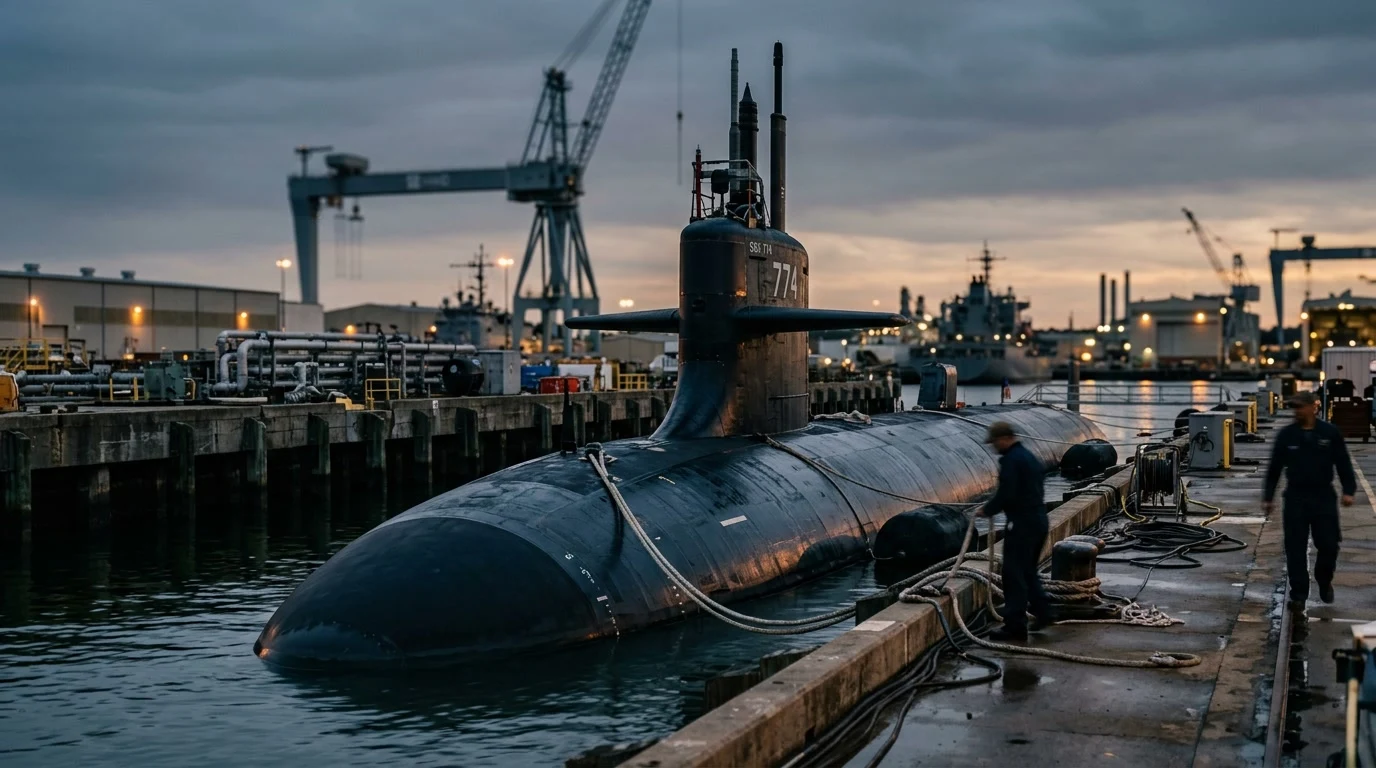
The Virginia class is the Navy's current attack submarine design, built jointly by General Dynamics Electric Boat and HII's Newport News Shipbuilding. Deliveries began with USS Virginia (SSN-774) in 2004, and roughly twenty boats had been delivered by 2025, according to Navy delivery announcements, with construction continuing through the Block IV batch and into Block V, which adds a Virginia Payload Module for additional cruise-missile capacity. The class succeeded the Seawolf class (SSN-21 through SSN-23), three boats built in the 1990s that remain the largest and, in Navy descriptions, quietest attack submarines in the force. Virginia-class boats are homeported in Groton, Connecticut, Norfolk, Virginia, and Pearl Harbor, Hawaii, with additional boats planned for Guam as documented in Navy posture statements. The class is mentioned here as fleet context only; its program details are covered separately on this site.
Why does the Navy have fourteen ballistic-missile submarines?
Fourteen Ohio-class SSBNs, based at Bangor, Washington, and Kings Bay, Georgia, carry the sea-based leg of the U.S. nuclear triad, each armed with Trident II D5 ballistic missiles, according to Navy fact files. The number fourteen is set not by the Navy alone but by strategic arms limitation agreements, which count launcher capacity; the Ohio class was designed for twenty-four missile tubes and the follow-on Columbia class for sixteen, and the SSBN force was sized at fourteen when the Navy and the Air Force divided triad roles in the 1990s and 2000s. Eight of the original eighteen Ohio hulls were converted or designated for other roles after the 1994 Nuclear Posture Review, leaving the fourteen SSBNs in service since the early 2000s. The class is aging against a fixed timeline: Navy documentation consistently states that each Ohio hull must retire at the end of its forty-two-year life, which is why the Columbia class is treated as the Department of Defense's highest-priority acquisition program.
What is an SSGN, and why are they going away?
Four Ohio-class hulls were converted in the 2000s into guided-missile submarines: USS Ohio (SSGN-726), USS Michigan (SSGN-727), USS Florida (SSGN-728), and USS Georgia (SSGN-729), according to Navy program history. Each removed its Trident missiles and installed twenty-two tubes configured for up to seven Tomahawk cruise missiles apiece, plus accommodations for special operations forces, making the SSGNs the Navy's largest conventional strike platforms undersea. Their role is documented in strike operations and in forward presence, with Michigan periodically forward-deployed. The category has no successor: Navy budget documents from the 2020s plan SSGN retirements in the mid-to-late 2020s as the hulls reach life limits, with Virginia Block V boats and their Virginia Payload Modules described in Navy submissions as the partial replacement for SSGN strike capacity. The SSGN retirement is one of the documented capability gaps in Navy force planning, acknowledged repeatedly in Congressional testimony without a funded one-for-one solution.
What is the Columbia class, and when does it arrive?
The Columbia class is the Ohio SSBN replacement: twelve boats planned, with lead ship USS District of Columbia (SSBN-826) under construction at Electric Boat and delivery planned around the end of the 2020s, according to Navy program documentation through 2025. Each Columbia replaces an Ohio on a one-for-one basis and must be on patrol before the corresponding Ohio hull retires, a sequencing requirement the Navy calls non-negotiable because the triad's sea leg cannot tolerate a gap. The program's construction rate is fixed at one boat per year, consuming a large share of national submarine industrial capacity, which Navy and industry reports identify as the reason Virginia-class production cannot simply be raised to cover attack-sub shortfalls. The program is covered in detail in a separate guide on this site.
How do the categories add up for 2026?
The documented arithmetic as of 2025 is as follows: an attack submarine force of roughly fifty, declining unless Virginia deliveries accelerate; an SSBN force holding at fourteen until Columbia deliveries begin; and an SSGN force of four, scheduled to disappear within the decade. Navy long-range plans describe a total submarine force in the high forty to low fifty range through the transition years, with growth dependent on shipyard output rather than procurement decisions alone. For readers tracking the fleet, the three numbers to watch are documented and stable: Virginia deliveries per year, Columbia construction milestones, and the dates of Los Angeles and SSGN retirements published in successive Navy budget submissions.