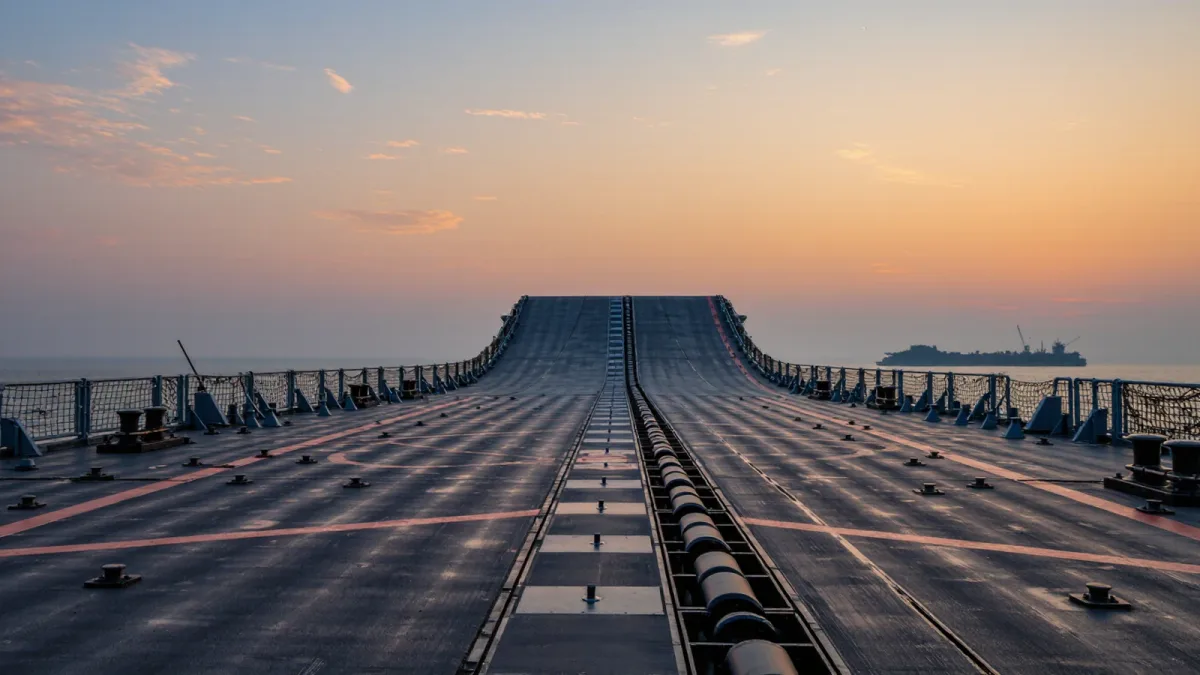
The Electromagnetic Aircraft Launch System, EMALS, launches carrier aircraft by pulling them down the deck with a linear induction motor powered from flywheel energy storage, in place of the steam pistons that drove U.S. Navy catapults since the 1950s. Per the Navy's program descriptions, EMALS is fitted on the Gerald R. Ford (CVN-78), commissioned in July 2017, and on subsequent Ford-class carriers, where it launches everything from the E-2D Hawkeye to the F-35C with electronically controlled force profiles that a steam catapult cannot match.
How did steam catapults work, and why replace them?
The C-13 steam catapult that equips Nimitz-class carriers taps steam from the ship's propulsion boilers into a cylinder beneath the deck. A piston races down the cylinder when steam is admitted behind it, towing the aircraft's launch shuttle along the deck. Steam catapults launched tens of thousands of sorties over seven decades, but they are hard to tune: per Navy and contractor descriptions, the steam valve is adjusted mechanically before each shot, the launch energy is set in coarse steps, and the stroke begins with a hard jolt as pressure spikes, loading the airframe with stress that shortens airframe life.
Steam also ties the catapult to the propulsion plant. On a nuclear carrier that is survivable, but it means catapult performance depends on boiler state, and the system wastes most of the steam it uses. As early as the 1990s and formally in the early 2000s CVN-21 program studies, the Navy concluded that an electric launch could deliver energy more precisely and shed the steam infrastructure entirely.
How does EMALS launch an aircraft?
EMALS replaces the piston-and-cylinder with a moving armature inside a linear induction motor. Per the Navy's published descriptions, the launch sequence runs as follows.
- Energy storage. Flywheel-generator sets spin up on ship's power, storing the energy of one launch per flywheel pair without disturbing the rest of the electrical grid.
- Power conversion. Before the shot, cycloconverters condition the stored energy into the precise current waveform the shot requires.
- Launch stroke. Current is fed into sequential motor sections along the 300-foot trough, creating a traveling magnetic wave that drags the armature and shuttle forward at up to the launch speed of a fully loaded fighter.
- Control throughout the stroke. The software shapes acceleration continuously, giving the aircraft a gentler start and a defined end-of-stroke profile, and varying launch energy to match the airframe's weight and configuration.
- Recovery. After the shuttle stops, the armature is returned to the start position electrically, and the system reports shot data for maintenance trending.
The aircraft connects to the shuttle through the same launch bar and holdback as on steam cats, so deck procedures differ less than the machinery underneath.
What are the advantages over steam?
Per Navy program statements and Government Accountability Office reporting on the Ford class, EMALS offers three practical advantages. First, launch energy is adjustable across a wide, fine-grained range, which allows lighter unmanned aircraft to be launched without the airframe abuse of an oversized steam shot and lets heavy aircraft get more energy than a steam cat can deliver at the top of its envelope. Second, the system is expected to be less stressing on airframes and to require a smaller crew for operation and maintenance. Third, it is integrated with the Ford class's electrical propulsion architecture, removing the steam piping and dehumidification burden of the legacy system.
The Navy has also cited higher launch availability targets and faster sortie generation as program goals, figures that have been debated in GAO and CRS reporting as the class matures.
What problems has EMALS had?
The development path was rough. Per GAO assessments of the Ford class from 2013 through the early 2020s, EMALS and the related Advanced Arresting Gear were the class's principal risk items: early reliability was far below requirements, with mean cycles between critical failures reported in the hundreds of aircraft launches rather than the thousands specified, and the systems could not be maintained without spares and technical data support that arrived slowly. Launch failures in early at-sea periods, per Navy test agency reporting, traced to power conversion and control software issues.
Reliability improved as the fleet gathered sorties through Ford's 2022 and 2023-2025 deployments, per Navy public affairs statements from those periods, though the GAO continued to flag parts support and the challenge of simultaneous catapult operations as watch items. The Navy has not disclosed current reliability figures in public budget documents beyond noting continued growth.
Where is EMALS fitted, and what comes next?
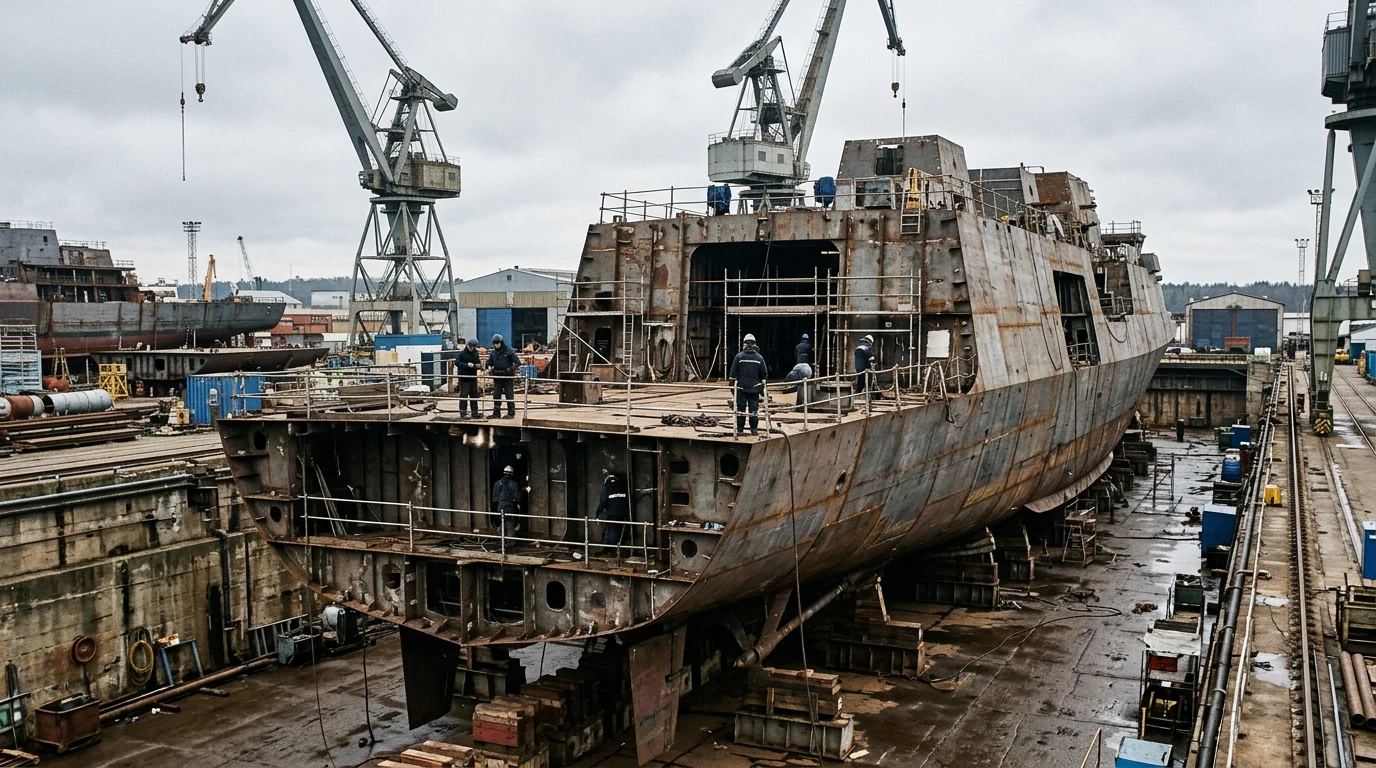
As of March 2026, EMALS is installed on the carriers of the Gerald R. Ford class in commission and construction: the lead ship Gerald R. Ford (CVN-78), the John F. Kennedy (CVN-79), and the Enterprise (CVN-80) and Doris Miller (CVN-81) at earlier stages of construction, per Navy program reporting through 2025. No backfit to Nimitz-class ships is planned. Abroad, the electromagnetic launch concept has been adopted by China's third carrier, per open-source reporting since 2022, indicating that electric launch is now the reference design for new large-deck carriers rather than an American experiment.
How does EMALS interact with the carrier's electrical grid?
EMALS is one of the heaviest intermittent loads a warship has ever placed on its own electrical plant, and the Ford class was architected around that fact. Per Navy descriptions of the class's electrical propulsion design, the ship generates and distributes electrical power at medium voltage and feeds it to both the motors driving the propeller shafts and the catapult system, an arrangement called integrated electric propulsion. Each launch draws energy from dedicated flywheel storage rather than directly from the grid, so the shot does not sag the ship's power distribution or trip the radars, and the flywheels recharge at a rate the plant can sustain between cycles.
That architecture is why EMALS could not simply be backfitted into a Nimitz-class hull. The steam cat drew on the reactors' thermal output, already plumbed; EMALS demands a grid with enough generation and switching to charge flywheels, run the power conversion electronics, and feed arresting gear, all while the ship maneuvers on electric drive. Per GAO reporting on the class, this integration was among the reasons early availability periods ran long, as power electronics faults in one subsystem cascaded into others. The offset, per Navy program statements, is a ship that allocates electrical power dynamically, and a launch system whose maintenance is electrical rather than mechanical trades in a navy that has historically struggled to retain steam-certified technicians.