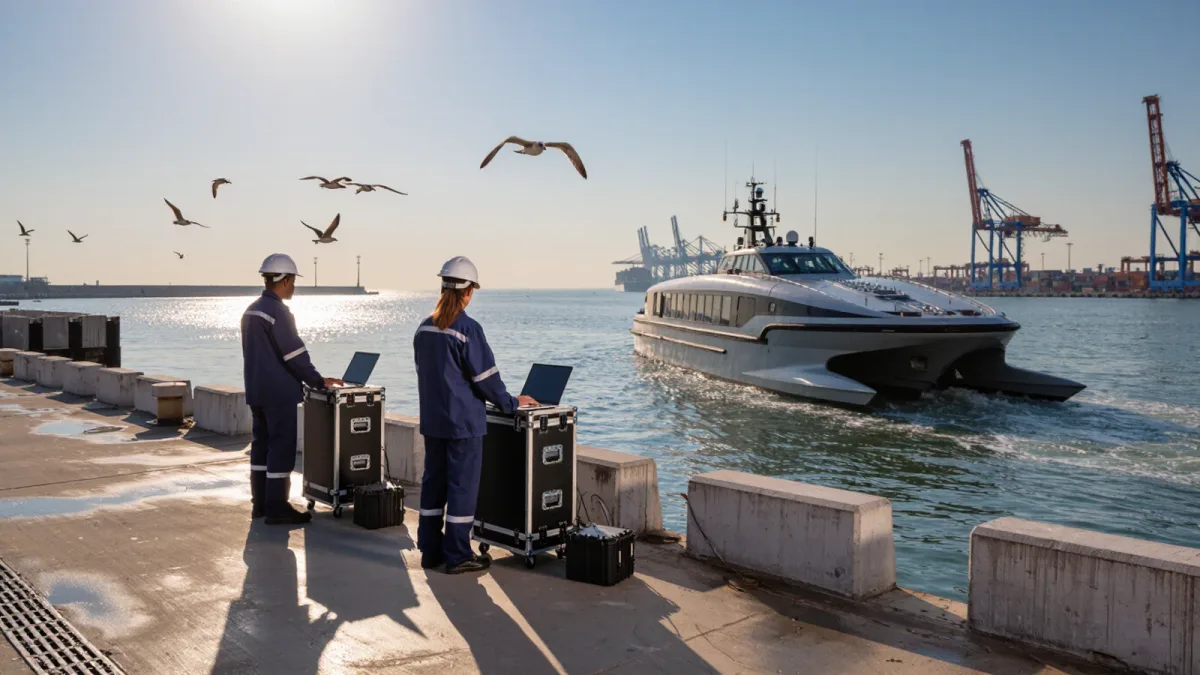
Unmanned surface vessels, USVs, are crewless boats that navigate and execute missions under remote supervision or onboard autonomy, and as of June 2026 they span three classes in U.S. Navy planning: small experimental and surveillance hulls, medium vessels like the DARPA-derived Sea Hunter, and the large unmanned surface vessel, LUSV, a missile-carrying design intended to add magazine depth to the fleet without adding crews. Per Navy and Congressional Research Service reporting, the transition from experimentation to acquisition has been slower than early plans assumed, but the vessels have accumulated transits, fleet exercises, and at least one missile launch along the way.
What is Sea Hunter and where did it come from?
Sea Hunter is the 132-foot trimaran built under the Defense Advanced Research Projects Agency's Anti-Submarine Warfare Continuous Trail Unmanned Vessel program, launched in 2016. Per DARPA and Navy announcements, the vessel demonstrated fully autonomous operation, including the legal requirement of avoiding collisions under international rules, and in 2019 completed a round trip between San Diego and Hawaii largely self-navigated, with a planned return leg aborted for a propulsion defect. The craft transferred to the Office of Naval Research in 2018 for continued experimentation and continues to serve as an autonomy testbed.
Its significance is less the hull than the autonomy software and the proof that a medium vessel can cross an ocean with no crew aboard. A related hull, Sea Hawk, a Leidos-built medium USV delivered to the Navy in 2021 per service announcements, extended that line into fleet experimentation, including participation in Pacific exercises.
What is the Ghost Fleet Overlord program?
Ghost Fleet Overlord is the Navy's conversion of commercial fast supply vessel designs into large unmanned test ships. Per Navy and program reporting through 2025, the vessels Ranger, Nomad, Vanguard, and Mariner have conducted increasingly ambitious demonstrations: Ranger and Nomad transited to the Western Pacific with crews embarked only for portions of the voyage, and in 2021 Ranger launched a Standard Missile-6 from its deck-mounted launcher during a live-fire demonstration, the first missile launch from an unmanned surface vessel of this size.
Overlord's purpose is risk retirement. The Navy uses these hulls to mature command and control, autonomy behaviors, reliability, and launch concepts before committing to production designs, per budget documents from fiscal years 2021 through 2026. The program's lessons flow directly into the LUSV requirement.
What is LUSV intended to do?
The large unmanned surface vessel is planned as a crewless missile truck: a hull in the 200-foot class carrying vertical launch cells for Tomahawk and Standard Missiles, sailing in company with crewed combatants and controlled from a mothership or shore node. Per Congressional Research Service reporting through 2026, the concept is magazine depth at lower cost, since the vessel carries no crew habitability systems and a smaller combat suite than a destroyer.
The program's history is a study in budget friction. Navy budget requests for LUSV from fiscal year 2021 onward proposed procurement funding, and Congress repeatedly pared or restructured those requests, citing immature requirements and unproven reliability, per CRS analyses of successive defense appropriations. As of mid-2026, per the same reporting, the Navy continues prototyping and industry concept work rather than full-rate production, and the first production contract remains pending.
How are unmanned vessels commanded and controlled?
A USV runs on a layered control model. Onboard autonomy handles station keeping, collision avoidance, and route following, the tasks that must react in seconds. A remote operator supervises from a control station, approving mission changes and, where policy requires, key decisions. Communications travel over satellite links with line-of-sight radios for close operations, and the control stations are designed so one team can supervise several hulls, per Navy descriptions of its unmanned systems experimentation in the Pacific Fleet's unmanned surface vessel divisions.
U.S. Fifth Fleet's Task Force 59, established in September 2021, tested the same model in the Middle East, meshing commercial and government unmanned surface and undersea craft into a maritime awareness network, per Navy announcements from that period. Its tracked figures for cumulative days at sea, published periodically through 2024-2025, made it the fleet's most productive unmanned testbed.
What stands between experimentation and the fleet?
Three problems recur across program documents. Autonomy certification: the Navy must prove that a crewless hull behaves predictably among merchant traffic, which international collision regulations were written assuming a human watchstander. Reliability: budget testimony through 2025 described medium and large USV reliability as still below crewed-ship standards. And doctrine: the fleet is still defining how a missile-carrying robot fits rules of engagement, maintenance pipelines, and operational law. Per CRS reporting, these are the reasons LUSV procurement slipped repeatedly, and as of June 2026 they remain the pacing items for the Navy's unmanned ambitions.
What other USV classes is the Navy testing?
Beyond the medium Ghost Fleet hulls and the large LUSV concept, the Navy's experimentation base includes two smaller families. The Global Autonomous Reconnaissance Craft, in service with the Navy's expeditionary and mine warfare communities since the 2010s, is a rigid-hull surveillance craft operated remotely for harbor and coastal patrols, per Navy descriptions, and it has been the fleet's workhorse for building operators' experience with crewless hulls. In parallel, commercial and naval shipbuilders have delivered small autonomous boats under various prototypes for tow, survey, and patrol missions, several of which served in Fifth Fleet's Task Force 59 mesh, per CENTCOM-area announcements from 2022 through 2024.
The class structure matters because each size raises different certification problems. A seven-meter patrol craft fails safely by beaching; a 300-foot missile barge does not, which is why autonomy standards, not sensor fits, pace the large programs. Per Congressional Research Service reporting through 2026, the Navy's stated approach is to let small and medium hulls accumulate reliability data and fleet habits while LUSV requirements mature, and to buy hybrid-manned options where a crewed fallback preserves operational flexibility. For planners, the fleet in 2026 is therefore best described as a growing unmanned periphery around a crewed core, with the balance point still an open budgetary question rather than a settled design decision.