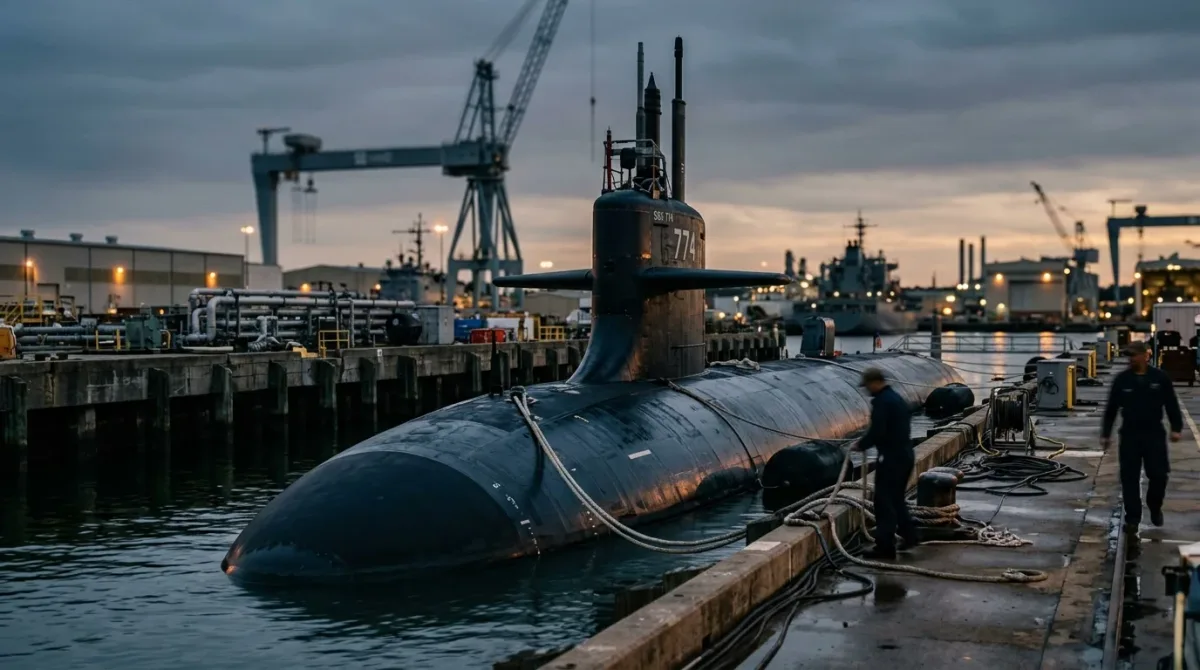
A modern military submarine is quiet because sound is the primary way to find one underwater, and the quietest boats push their radiated noise down toward the ambient level of the ocean itself. Per decades of open acoustic research and Navy descriptions of its acoustic superiority program, that result is achieved with four tools in combination: isolating machinery from the hull, shaping and slowing the propulsor, smoothing the water flow over the hull, and absorbing or managing the sounds the boat cannot eliminate.
Why does sound matter more than radar underwater?
Electromagnetic waves attenuate within meters in seawater, so neither radar nor optical sensors work at depth. Sound, by contrast, travels kilometers. Passive sonar listens for the noise a submarine makes; active sonar pings and listens for echoes. Per standard underwater acoustics references, the ocean's ambient background, from wave action, marine life, and distant shipping, sits around 50 to 90 decibels across the frequencies sonars use, and a submarine designer's goal is to keep the boat's contribution below that fluctuating floor at tactically meaningful ranges.
The contest is asymmetric. A quiet attacker hears a noisy target long before the reverse. That is why quieting is described by the Navy as the core of undersea survivability, and why noise measurements of new boats remain among the most closely held numbers in any navy.
How do engineers silence the machinery?
The machinery problem is structural. A pump, turbine, reducer, or diesel engine vibrates at its operating frequencies, and a rigid mount would carry that vibration straight into the pressure hull, which radiates it into the water like a speaker cone. The countermeasure is isolation, commonly called rafting: major machinery sits on resilient mounts, and critical equipment groups sit on rafts that are themselves mounted on further layers of isolation, so vibration passes through rubber and steel springs that damp it at each stage.
Per open descriptions of U.S. and allied submarine practice, designers also attack the sources directly. Rotating equipment is balanced to tight tolerances. Pumps are chosen or designed for low cavitation and low flow noise. Where the boat must run loud equipment, such as a diesel charging the battery at periscope depth, it does so through a snorkel mast while the crew manages flow noise around the mast itself. Pipes carrying fluid are run through flexible couplings so that flow noise does not walk through the plumbing into the hull.
What makes the propulsor quiet?
The propeller is the loudest single item once machinery is isolated. Two phenomena dominate. Cavitation forms vapor bubbles when blade surfaces drop below local pressure, and those bubbles collapse with an acoustic report that carries far. Blade-passing tones, the rhythmic pulse of blades slicing the wake, produce narrowband noise that sonar operators can identify and classify.
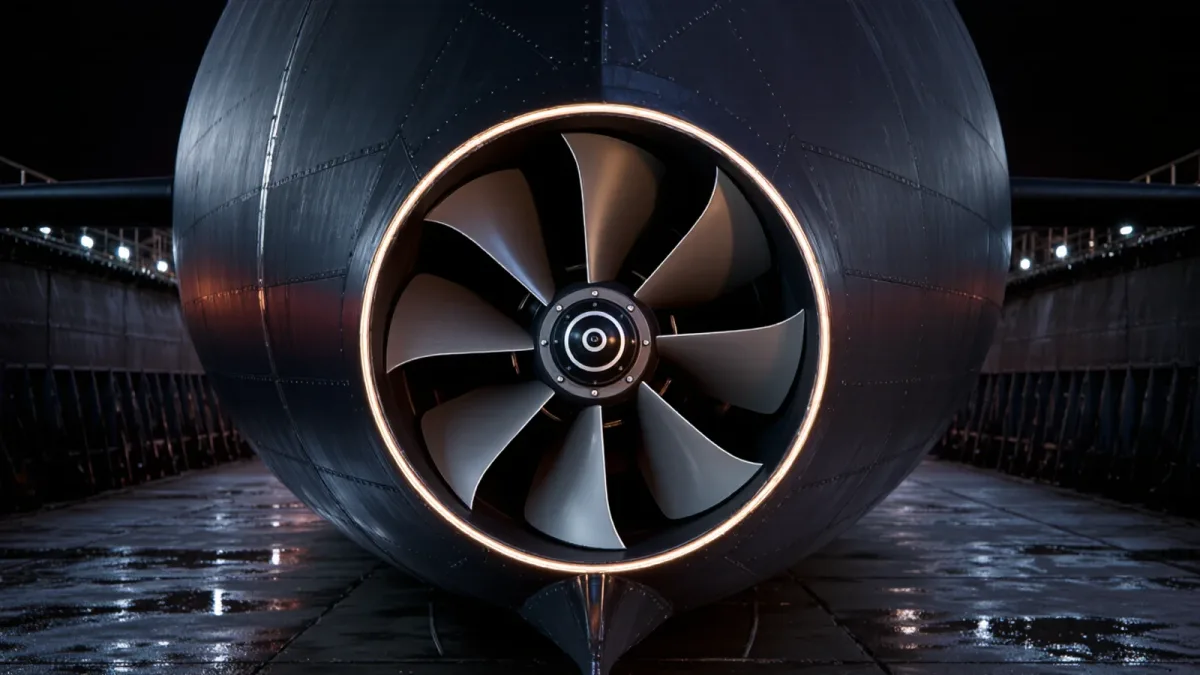
Modern submarines respond with highly skewed propellers on nuclear boats, which spread each blade's load unevenly so cavitation inception is delayed to higher speeds, and with pump-jet propulsors, shrouded impeller-and-stator combinations used on the Seawolf-class and Virginia-class attack submarines and the Royal Navy's and others' modern SSBNs. Per Navy and industry descriptions, a pump-jet trades some efficiency for a lower acoustic signature, because the duct smooths the inflow and the stator straightens the swirl before it becomes radiated noise. Turning slower at larger diameter also helps, which is why quieter boats give up little speed for silence compared with their predecessors.
What about the hull and the flow around it?
Hydrodynamic noise rises with speed. Turbulent flow over hull openings, flood holes, free-flooding spaces, and protruding masts generates broadband noise, and any cavity or edge can whistle or shed vortices that a passive sonar can hear. Designers minimize openings, cover them with flow-smoothing grating and retractable panels, fair every projection, and keep hull surfaces clean, since marine growth roughens the boundary layer and raises the noise floor even at modest speeds.
Many boats also carry anechoic coatings, rubberized or elastomeric layers on the outer hull that absorb a portion of incoming active sonar energy and damp some internal noise before it radiates. Per published descriptions of Russian and Western practice, these coatings do not make a boat invisible, but they measurably shorten the range at which active sonar returns a usable echo, and they are one reason modern submarine hulls look matte and textured rather than glossy.
How is quietness actually measured and kept?
Radiated noise is measured on instrumented ranges, stretches of deep water with arrays of hydrophones on the seabed, where the boat runs prescribed courses and speeds over the array and the signature is reconstructed from the recordings. Per Navy descriptions of its acoustic trial process, new-construction submarines complete such trials before operational certification, and classes return to ranges periodically because a signature can drift as equipment ages, coatings degrade, or repairs alter a mounting.
Quietness is also a discipline aboard. Loose items are stowed so they cannot rattle; hatches, tableware, and machinery are secured; certain evolutions are restricted to times and speeds when their noise is least detectable. The result, per Navy statements on its undersea advantage, is a fleet whose acoustic signatures are among the most protected figures in defense, precisely because once a signature is known, every opponent's sonar library becomes a dossier on how to find that boat.