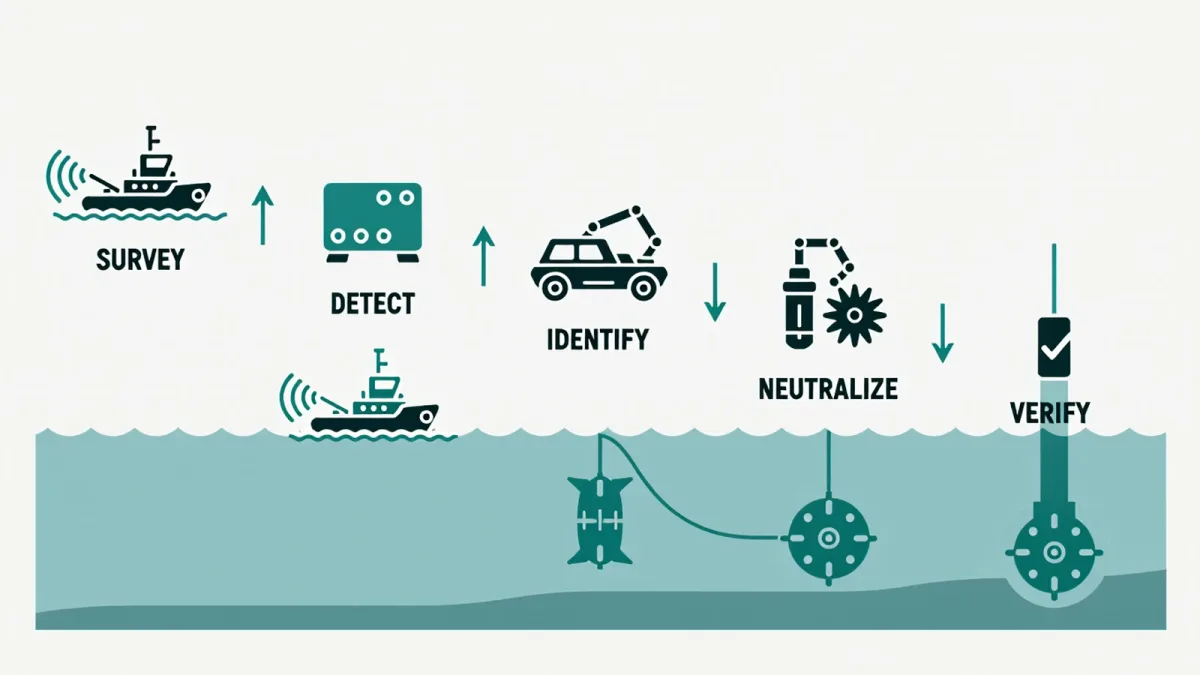
Naval mine countermeasures are the suite of technologies used to detect, classify, and neutralize sea mines, and as of April 2026 the U.S. Navy's approach has shifted from manned minesweeping ships toward remotely operated systems: unmanned surface craft towing minehunting sonar, expendable underwater vehicles, and helicopter-borne neutralization, all choreographed from the Avenger-class mine countermeasures ships and littoral combat ships fitted with the mine countermeasures mission package. Per Navy program reporting, the driver is simple: keep people out of the minefield.
What is a naval mine, and why is it hard to counter?
Sea mines fall into two broad families. Moored mines float on tethered buoyancy a few meters under the surface, where they can strike a ship's hull; bottom mines rest on the seabed in shallow water. Both have shifted from contact fusing, in which the hull must touch the mine, to influence fusing, in which the mine fires on the magnetic, acoustic, or pressure signature of a passing ship, often with programmable logic and counters that let it ignore the first few contacts.
Influence mines are hard to counter for three reasons. They are cheap, so an adversary can seed hundreds for the cost of a single ship. They are passive, generating no signature to detect until they are found deliberately. And they impose area denial silently: per Navy damage history, mines damaged the cruiser USS Princeton (CG-59) and the amphibious assault ship USS Tripoli (LPH-10) in the northern Persian Gulf in February and April 1991 respectively, in a campaign where the coalition controlled the air and sea everywhere except the minefields it had not yet cleared.
How does minehunting differ from minesweeping?
The distinction is fundamental. Minesweeping drags a device through the water or along the seabed to stimulate mines into firing, whether a wire sweep cutting mooring cables or a sled generating magnetic and acoustic signatures to dupe influence mines. It clears a path without ever finding the mine. Minehunting, by contrast, searches for the mine itself, detecting and classifying it on sonar, then identifying it optically and neutralizing it individually.
Hunting is precise but slow; sweeping is faster but indiscriminate, and modern programmable mines are designed to discriminate against sweep signatures. Per Navy doctrinal descriptions, modern operations combine both: hunt first to map the field, sweep if a path must be opened quickly, and accept that the standards differ by mission, with merchant convoys cleared to a lower confidence threshold than an amphibious landing lane.
What systems does the U.S. Navy use today?
As of April 2026, per Navy budget and program documents through fiscal year 2025, the mine countermeasures toolkit includes:
- Avenger-class mine countermeasures ships, wooden-hulled hunting and sweeping vessels built in the 1980s and 1990s, which the Navy has been retiring as their mission migrates to unmanned systems.
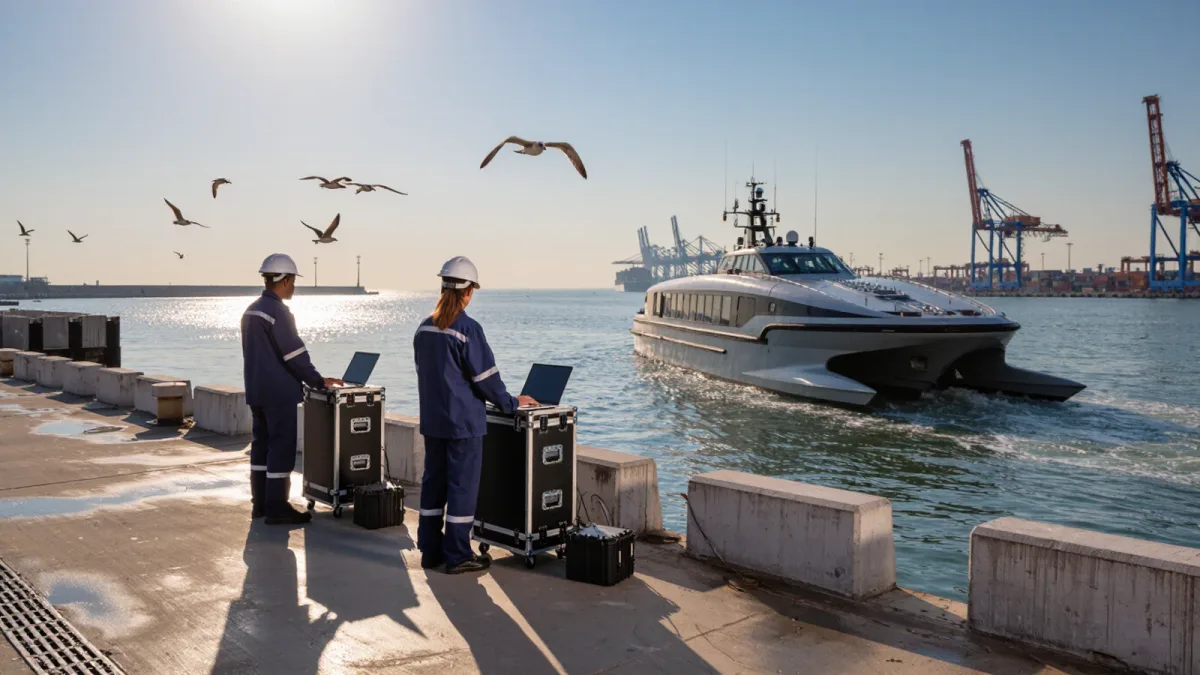
- The mine countermeasures mission package for littoral combat ships, which embarks the minehunting unmanned surface vessel, a small boat towing a variable-depth sonar, plus helicopter support.
- Knifefish, an unmanned underwater vehicle per Navy program descriptions, that emits a low-frequency broadband signal to detect and classify buried and volume mines ahead of a transit lane.
- The airborne mine neutralization system, carried by MH-60S helicopters, which delivers small expendable neutralizer vehicles that destroy mines underwater without a diver or sweep in the field.
- Sea Fox-class and similar small rigid inflatable mine neutralization craft operated from larger ships for close-in disposal.
The architecture is deliberately distributed: no single crewed platform must enter the suspected field, and each detection-to-neutralization step is run remotely.
How does a minehunting sequence actually run?
A typical clearance follows five steps, per Navy mission package descriptions.
- Survey. The minehunting unmanned surface vessel tows its sonar along lane patterns over the suspect area, building side-looking sonar imagery of the seabed and water column.
- Detection and classification. Operators and automated aids flag objects on the sonar record whose shape, shadow, and motion history fit mine-like criteria.
- Identification. An underwater vehicle or diver inspects each flagged object at close range with optical and sonar sensors to confirm or dismiss it.
- Neutralization. A helicopter or surface craft delivers an expendable neutralizer to the confirmed mine, which is destroyed in place.
- Verification and marking. The lane is re-surveyed or re-swept to the confidence standard required, and the cleared route is marked and reported to traffic.
Each step trades time for certainty, and the historical lesson from both Gulf mine campaigns is that clearance rate, not technique, decides operational impact.
Why is the Navy moving to unmanned countermeasures?
The Navy's fiscal year 2025 and 2026 budget documents describe the retirement of the Avenger class and continued fielding of unmanned systems as the long-planned transition to a distributed mine countermeasures force. The rationale is casualty avoidance, since mines exist precisely to punish ships that enter their field, and cost, since a sonar-towing boat with a small crew costs a fraction of a purpose-built hull to operate. Allied navies are on the same path, per published program reporting from several European fleets, which matters because combined operations in the Gulf and the Baltic, the two seas where mines have done the most damage since 1980, will increasingly be cleared by mixed unmanned formations rather than dedicated minesweeper hulls.
What has history taught about mine warfare?
The lesson set is consistent across conflicts. Per Navy historical summaries, mines damaged or sank more U.S. ships in the Korean War than air attack, and the two 1991 Persian Gulf incidents involving Princeton (CG-59) and Tripoli (LPH-10) demonstrated that even a force with total command of the air cannot push ships through an uncharted field without risk. In 1988, a single Iranian moored mine in the Gulf, laid in classic fashion during the Iran-Iraq War's tanker conflict, nearly broke the keel of the frigate USS Samuel B. Roberts (FFG-58), an event whose retaliation, Operation Praying Mantis, remains the Navy's largest surface engagement since 1945.
The recurring findings shape today's programs. Mines are most effective as area denial, not ship-killing: they close straits and harbors, forcing the adversary to clear on the defender's schedule. Clearance takes time out of proportion to the mines involved, because confidence, not destruction, is the product. And the side that keeps its own MCM forces current deters mining in the first place, since a field only pays if the victim lacks the means to clear it. Per Navy budget narratives through fiscal year 2026, that deterrence logic is cited explicitly as the justification for sustaining unmanned mine countermeasures investment even in flat budget years.