The U.S. Navy and the U.S. Coast Guard are both armed forces, but they are organized, funded, and legally tasked as different instruments. The Navy, a service within the Department of the Navy under the Department of Defense, fights and deters at and from the sea. The Coast Guard, a military service and federal law enforcement agency that has operated within the Department of Homeland Security since March 1, 2003, enforces U.S. law on the water, saves lives, and protects ports. Title 14 of the U.S. Code provides that the Coast Guard operates as a service in the Department of the Navy in time of war or when the President so directs, a transfer that has been invoked in every major U.S. conflict since the Second World War.
This is a policy explainer, not legal guidance; naval-pages.com publishes information, not legal advice.
Why does the United States have two armed sea services?
The split is historical and functional. The Coast Guard's lineage dates to August 4, 1790, when Congress created the Revenue Cutter Service to enforce tariff laws; life-saving and lighthouse services merged into the modern Coast Guard by 1915, and the service moved from the Treasury Department to the Department of Transportation in 1967 and to Homeland Security in 2003. The Navy, established by the Naval Act of 1794 to contest Barbary corsairs and protect commerce, grew into a blue-water combat force. The functional logic remains: one force is optimized for warfighting at scale, the other for peacetime authority on domestic and international waters. Law enforcement is a military mission in the Coast Guard by design, whereas Navy personnel are barred from most domestic law enforcement by the Posse Comitatus framework.
What are the statutory missions of each service?
The Coast Guard's eleven statutory missions, listed in Title 14, cover ports, waterways and coastal security; drug and migrant interdiction; aids to navigation; search and rescue; living marine resources; marine safety; defense readiness; marine environmental protection; ice operations; law enforcement; and other operations the President may direct. The Navy's missions are not enumerated the same way; its stated responsibilities run to sea control, power projection, deterrence, maritime security, and sealift support of the joint force, organized around carrier strike groups, submarine forces, expeditionary forces, and the logistics train. The comparison below draws the distinction at the mission level.
| Dimension | U.S. Navy | U.S. Coast Guard |
|---|---|---|
| Peacetime department | Department of Defense (Department of the Navy) | Department of Homeland Security |
| Core function | Sea control, power projection, nuclear deterrence | Maritime law enforcement, safety, port security |
| Law enforcement authority | Limited by the Posse Comitatus framework | Full federal law enforcement authority at sea |
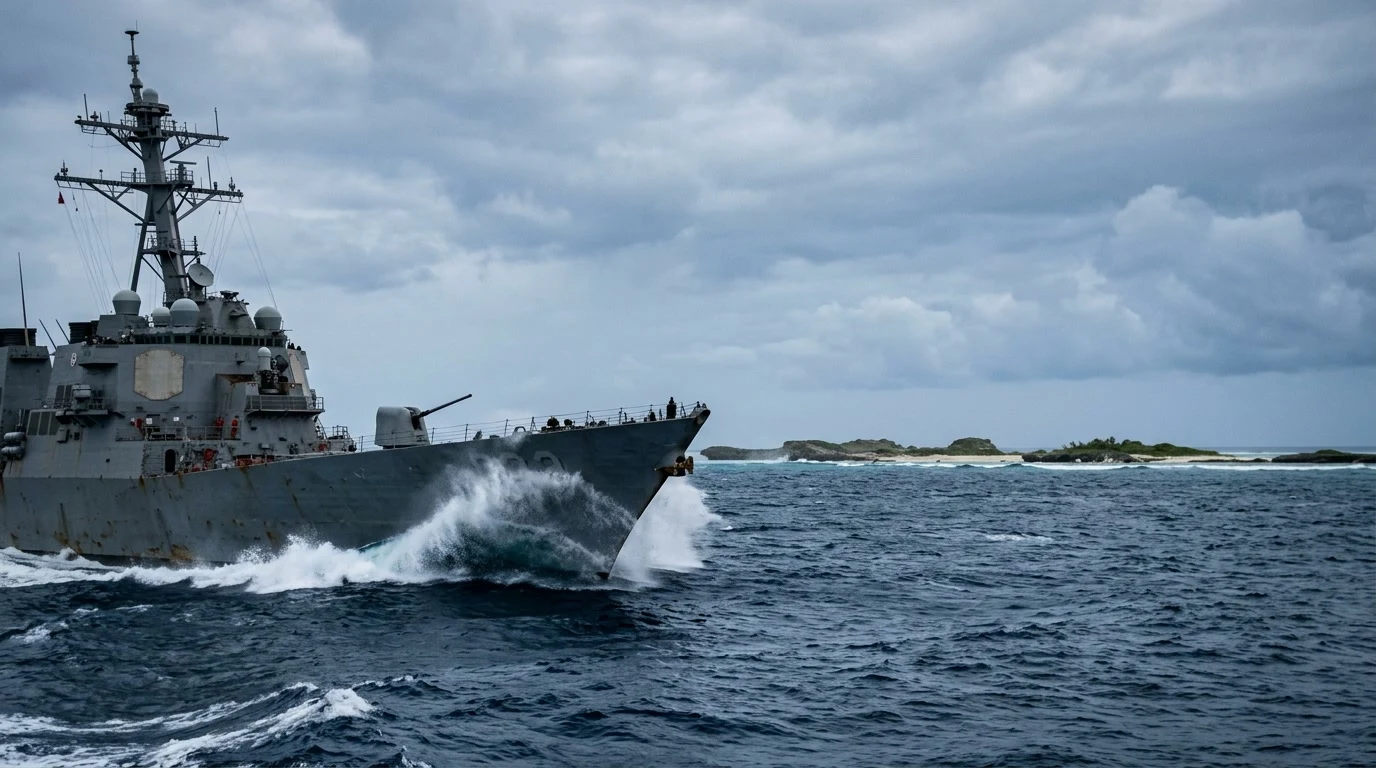
| Typical units | Carriers, destroyers, submarines, amphibious ships | Cutters, boats, aircraft, port security units |
| Wartime posture | Combatant command forces | Transfers to the Department of the Navy by statute |
How does the wartime transfer to the Navy work?
Title 14 provides two triggers. In time of war, or when the President directs, the Coast Guard operates as part of the Department of the Navy and remains there until the President or Congress returns it to its peacetime department. The transfer has practical consequences: Coast Guard cutters can be assigned to naval task forces, Coast Guard crews come under naval operational command, and the service's defense readiness mission, exercised constantly in peacetime through joint training, takes over its primary identity. Coast Guard personnel fought in every major U.S. war; cutters and Coast Guard crewed vessels participated in the Normandy invasion in June 1944, where they performed rescue and screening duties, and the service's endurance cutters and patrol boats deployed to Vietnam under Operation Market Time in the 1960s. In the post-2001 period, Coast Guard port security units and cutters deployed to the Persian Gulf region in support of naval coalition operations.
Do the two services overlap in operations?
Constantly, by design. The Navy's ships cannot board foreign vessels in most interdiction cases without law enforcement authority, so the standard arrangement puts a Coast Guard law enforcement detachment, a small team with boarding authority, aboard Navy warships for counter-drug and migrant interdiction patrols. The services share the maritime strategy documents published in recent years alongside the Marine Corps, and their headquarters coordinate on shipbuilding through the naval vessels acquisition processes in appropriations law, where large cutters are funded through the National Security Cutter and Offshore Patrol Cutter programs rather than the Navy's SCN account. At the operational level, Coast Guard districts and Navy fleets coordinate on maritime homeland defense, and the Coast Guard's National Command Center ties into joint maritime domain awareness networks.
How are the two services sized and funded differently?
The Navy operates a battle force measured in the hundreds of major combatants, including nuclear-powered carriers and submarines, with a budget that has run above $200 billion annually in recent fiscal years according to department budget submissions. The Coast Guard operates cutters, boats, and aircraft, with a budget an order of magnitude smaller, above $13 billion in recent fiscal years per its congressional budget submissions. Funding paths differ as well: the Navy's ship construction flows through the Department of Defense appropriations structure described in this site's budget cycle explainer, while Coast Guard acquisition is funded through the Homeland Security appropriations acts, with the Acquisitions, Construction and Improvements account carrying major cutter programs. Personnel cultures reflect the difference in scale; the Coast Guard's total active force is a fraction of the Navy's, spread across a mission set dominated by domestic waters.
Which service handles an incident in U.S. waters?
As a rule of thumb, anything with a law enforcement, safety, or environmental component in U.S. waters belongs to the Coast Guard first: search and rescue, marine casualty investigation, port state control, and pollution response. Anything involving a foreign military threat or a naval vessel belongs to the Navy. In practice the two respond together, with the Coast Guard leading incidents inside the U.S. exclusive economic zone that end in citation or prosecution and the Navy leading those that require combat capability. Joint on-scene coordination agreements, exercised through annual training, assign tactical control case by case rather than by rigid boundary.