The defense budget process is the annual sequence by which the United States military services ask for money, the Department of Defense shapes those requests into a single proposal, and Congress decides, by law, what the services actually receive. Naval shipbuilding sits inside that sequence. A ship class is funded years apart from when it is requested, and years apart from when it sails.
The scale explains why the process matters. According to Wikipedia's entry on the Department of Defense, the department's annual budget was $842 billion in fiscal year 2024, spread across the Army, Navy, Air Force and Space Force and a large set of defense agencies. The Navy's share of that total competes with every other service's priorities, and the fight over shares happens before any single ship is debated.
This guide walks the process in order: who asks, who shapes, who decides, and what can go wrong between a shipbuilder's contract and a hull in the water. For a narrower treatment of the shipbuilding accounts specifically, see How Congress Funds Navy Shipbuilding: The Budget Cycle Explained. We covered a connected angle in How Congress Funds Navy Shipbuilding: The Budget Cycle Explained. Readers following this should also see How Congress Funds Navy Shipbuilding: The Budget Cycle Explained.
Who starts the process, and what do the services actually submit?
The process starts inside the services. The Department of the Navy, which covers both the Navy and the Marine Corps, builds an internal list of what it wants: new ships, aircraft, munitions, maintenance, pay, and research. Each item competes against the others inside the service itself before anyone outside sees the list.
That internal list then goes to the civilian leadership of the Department of Defense, headquartered at the Pentagon in Arlington County, Virginia. The department's stated mission, in the words quoted in the Department of Defense's own entry, is "to provide the military forces needed to deter war and ensure our nation's security" — but its practical job in budget season is arbitration. It weighs the Navy's request against the Army's, the Air Force's and the agencies', and produces one consolidated department proposal.
The result is the President's Budget, the formal request the executive branch sends to Congress. From that point on, the services no longer control the numbers. Congress does.
What does Congress do with the request?
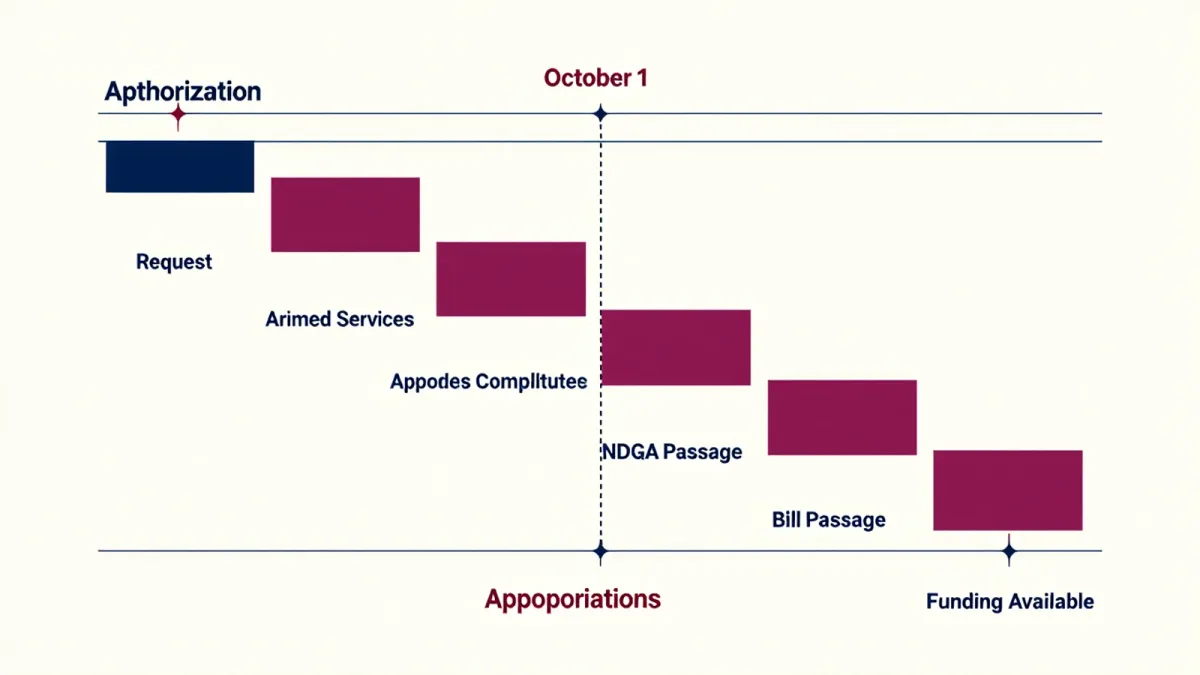
Congress holds the constitutional power of the purse: no money moves without a law. Two kinds of law matter, and they do different jobs.
An authorization act says what the department may do. It approves programs, sets policy conditions, and authorizes ship construction — but authorizing a program does not fund it. An appropriations act provides the money itself. A ship can be authorized in one bill and appropriated in another, and a program that is authorized but not appropriated exists on paper only.
In practice, each chamber of Congress writes its own version of these bills, the two versions are reconciled, and the final bills go to the President. For readers who want the shipbuilding line items in detail, the shipbuilding section tracks how these accounts move year to year.
Where do naval shipbuilding dollars actually appear in the budget?
Shipbuilding money is not a single line item. A new ship's full cost is spread across accounts and across years: the vessel itself is paid for in procurement-type accounts, while the people who will crew it, the fuel it will burn and the maintenance it will need sit in other accounts.
Money for one year is also not money for the whole ship. Large vessels are typically funded across multiple fiscal years, with Congress appropriating a portion each year. This is why a canceled ship still costs money: earlier appropriations were already obligated to the shipbuilder under the contract.
The Department of the Navy is one of three military departments inside the Department of Defense, alongside the Army and the Air Force. According to Wikipedia's historical account, that structure dates to the post-World War II reorganization: Congress created the War Department on 29 September 1789, the War Department handled naval affairs until Congress created the Navy Department in 1798, and in 1949 all military departments became subordinate to the Secretary of Defense. The department itself traces to 18 September 1947, when it was formed as the National Military Establishment. That structure matters for money because the Navy Department submits one budget covering both naval shipbuilding and Marine Corps needs.
What happens when Congress and the President disagree?
The process assumes agreement, and disagreement is common. When Congress has not passed appropriations by the start of the fiscal year, it can pass a stopgap measure — often called a continuing resolution — that extends prior-year funding levels for a limited period. Coverage of these delays and related policy fights appears in the publication's government news section.
What this means for readers tracking a ship class
Our analysis of the process points to three practical takeaways for anyone following a naval program.
- Follow the account, not the announcement. A program announcement is a request. The binding decisions are the authorization act and the appropriations act, and a program's status can change at either step.
- Read the dates carefully. Budget documents describe a fiscal year, not a calendar year. A ship "funded in FY26" received money for a fiscal year that does not match the calendar, and construction follows the contract award, not the appropriation.
- Watch the reconciliation. The House and Senate versions of each bill differ, and the differences — a ship added in one chamber, cut in the other — are where the real decisions surface.
The process is slow by design. Congress writes the rules, the department plans years ahead, and shipbuilders build on even longer horizons. For readers who want the wider policy context around these fights, the policy section collects the coverage in one place.
Frequently asked questions
What is the difference between authorization and appropriation? Authorization is permission; appropriation is money. Congress authorizes a shipbuilding program in one act and funds it in another. A program can be authorized and never appropriated, in which case it does not proceed. Both steps are required before a contract is funded.
Why does shipbuilding money take so long to produce a ship? The budget process runs on an annual cycle, but ships take many years to design and build. A ship class is typically funded in portions across multiple fiscal years, and construction begins only after contracts are awarded. The delay between the first request and the first hull is measured in years, not months.
What is a continuing resolution? A continuing resolution is a temporary law that keeps the government funded at prior levels when full-year appropriations have not passed.
Who decides how much the Navy gets compared with the other services? Two levels of decision. Inside the executive branch, the Department of Defense shapes the department's single budget proposal across all services. Then Congress decides the final split in law. No service sets its own top line. Readers following this should also see Coast Guard vs Navy Explained: Two Sea Services, Different Missions, One Wartime Chain. We covered a connected angle in Coast Guard vs Navy Explained: Two Sea Services, Different Missions, One Wartime Chain.