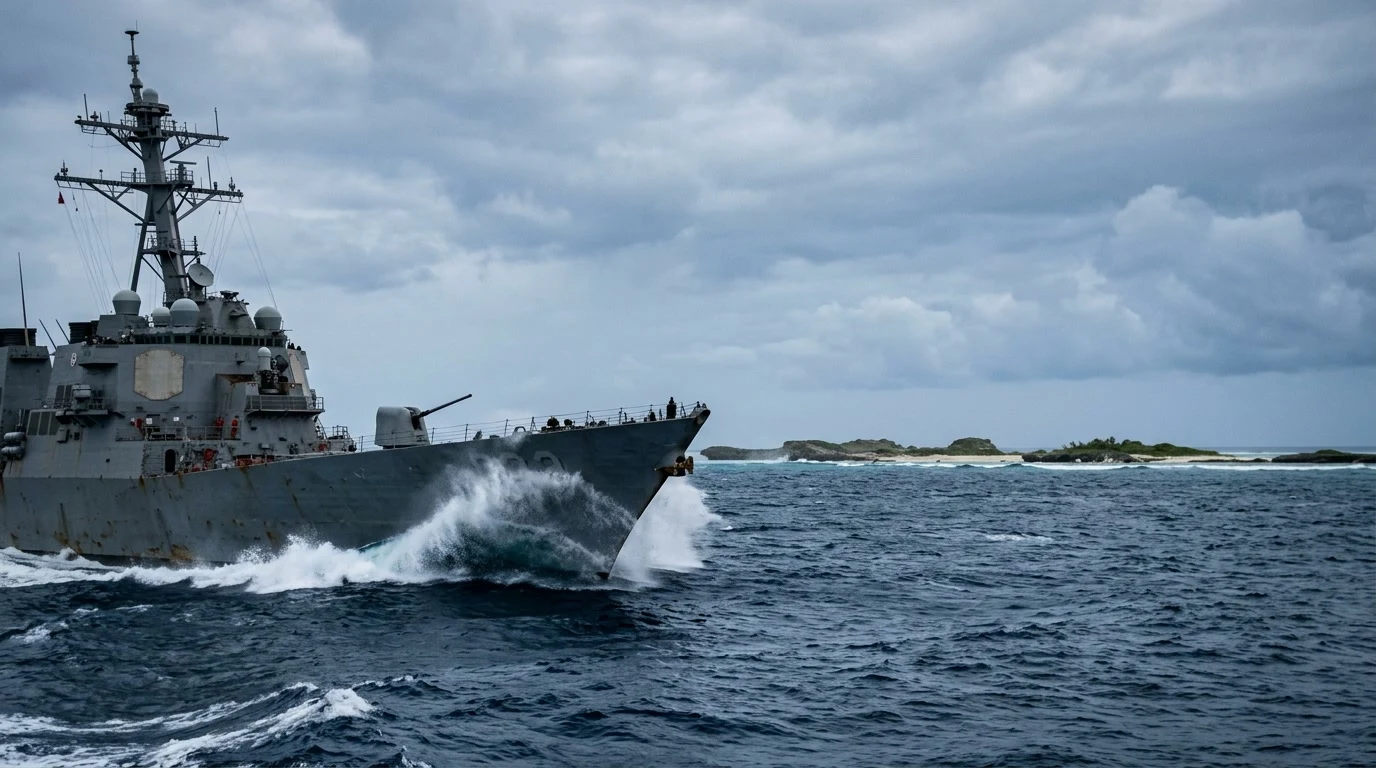
The United Nations Convention on the Law of the Sea, opened for signature at Montego Bay on December 10, 1982 and in force since November 16, 1994, sets the maritime zones and navigation rights that govern naval operations at sea. The United States signed the 1994 implementation agreement but the Senate has never given its advice and consent to ratification, so the United States remains a non-party. The U.S. Navy nonetheless navigates, overflies, and conducts operations under the convention's provisions, because successive administrations have accepted them as reflecting customary international law, beginning with President Reagan's 1983 Ocean Policy Statement.
This explainer addresses treaty law and maritime policy; naval-pages.com publishes information, not legal advice.
What maritime zones does UNCLOS establish?
The convention layers zones outward from a coastal state's shores, each with a defined balance of coastal rights and navigation freedoms. Naval planners work within these categories daily.
- Internal waters and the territorial sea: sovereignty extends to a territorial sea measured to a maximum of 12 nautical miles, subject to innocent passage by foreign ships.
- Archipelagic waters: for archipelagic states, sea lanes passage preserves transit across designated routes.
- The exclusive economic zone: to 200 nautical miles, coastal states hold resource rights while all states retain freedom of navigation and overflight.
- The high seas and the Area: the seabed beyond national jurisdiction, declared the common heritage of mankind under Part XI.
Why did the United States reject the 1982 text but accept the 1994 agreement?
The Reagan administration objected primarily to Part XI, the deep seabed mining regime, which it judged incompatible with free-market principles because it mandated technology transfer and an international mining authority with production controls. President Reagan announced in his 1983 Ocean Policy Statement that the United States would claim all rights the convention recognized, including navigation and overflight freedoms, while withholding signature because of Part XI. Negotiations between 1990 and 1994 produced the Agreement on Implementation of Part XI, adopted by the UN General Assembly on July 28, 1994, which restructured the mining regime, ended the technology transfer mandate, and gave the United States a seat on the implementing authority's council if it joined. President Clinton signed that agreement on July 29, 1994, and transmitted the package to the Senate.
What happened in the Senate?
The Senate Foreign Relations Committee has twice reported the convention favorably, in 2004 and again in 2007, with reservations and declarations attached. On both occasions the full Senate never voted. Opposition in floor debate has centered on arguments about sovereignty, the binding decision-making of the commission that defines continental shelf limits, and concerns that dispute settlement panels could constrain U.S. action. Support from the Defense Department and successive chairs of the Joint Chiefs has been consistent: testimony before the Foreign Relations Committee in the 2000s and 2010s repeatedly described treaty accession as the surest legal foundation for the Navy's operational claims. As of early 2026, the convention remains pending before the Senate.
How does the Navy operate under a treaty it has not joined?
Executive policy treats the convention's navigation provisions as customary international law binding on all states, so U.S. warships claim innocent passage through territorial seas, transit passage through international straits, and high-seas freedoms in the exclusive economic zone on that basis. The commander's handbook used by Navy judge advocates operationalizes these rules, and the State Department's publicly released limits papers assert the U.S. position on specific maritime claims around the world. Where a coastal state's claim exceeds what the United States recognizes under the convention, the Navy conducts operations to contest excessive claims; those operations rest on the same customary-law footing rather than on treaty membership. The practical consequence officials describe is that the United States asserts rights it cannot vote on and helps shape interpretation without a seat at the convention's institutions.
Which Navy missions depend most on UNCLOS rules?
Several operational categories hang directly on the convention's text. Submarine transits rely on the convention's treatment of submerged innocent passage and, more importantly, on strait transit passage, which preserves submerged transit where surface innocent passage would not. Carrier and surface groups depend on freedom of navigation and overflight in the exclusive economic zone, the largest zone on the map by area. Special operations and aviation training routes depend on the archipelagic sea lanes passage regime negotiated for island nations such as Indonesia and the Philippines. Coastwise, the convention's provisions on port state jurisdiction and resource enforcement shape Coast Guard and Navy cooperation in fisheries and interdiction work. Officers involved in these missions testify regularly that the convention's certainty, for example the fixed 12-mile territorial sea, reduces friction with coastal states.
What are the arguments for and against accession today?
Proponents argue accession locks in navigation rights at their strongest, strengthens credibility when the United States objects to others' maritime claims, and secures a role in continental shelf and seabed institutions, including the extended continental shelf process by which coastal states define seabed rights beyond 200 nautical miles; the U.S. extended continental shelf claim, finalized by the State Department in December 2023, was asserted under customary law without treaty membership. Opponents argue that the United States already obtains the rules it needs through custom and objection practice, that compulsory dispute settlement creates litigation risk, and that the seabed regime's institutions could evolve unfavorably over decades. The debate has remained substantially unchanged since 2004, and no Senate vote is scheduled as of early 2026.