The Navy's expeditionary sea base (ESB) program operates a small fleet of large, commercially derived ships configured as flexible seaborne bases for helicopters, small craft, and special operations forces. As of 2024 the class comprised six ships in service, led by USS Lewis B. Puller (ESB-3), according to Naval Vessel Register data and Navy delivery announcements, with the two lead hulls of the program originally commissioned as mobile landing platforms (ESD) before conversion. The ships matter out of proportion to their number: since 2021 they have maintained some of the most continuous forward presences in the fleet, including a standing deployment to the Mediterranean under U.S. European Command and regular operations in the Middle East. This guide explains what the ships are, how they are crewed, and what missions they perform.
What is an expeditionary sea base?
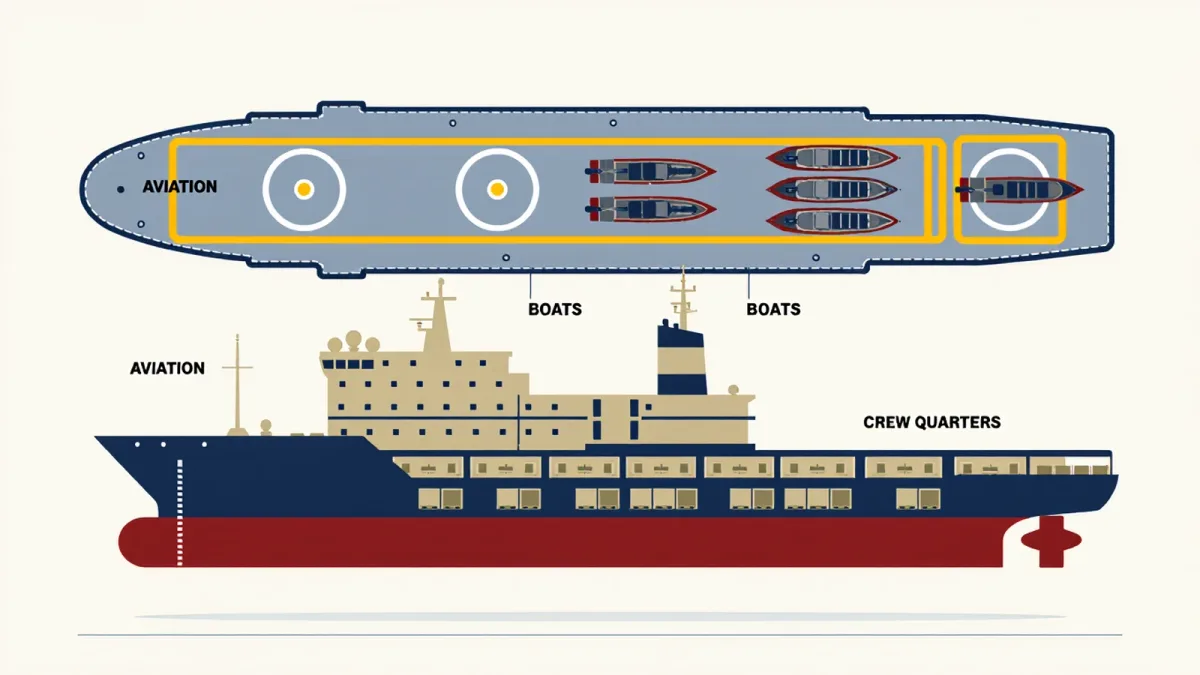
An ESB is a 78,000-square-foot-flight-deck ship built on the hull of the Navy's mobile landing platform design, itself derived from an Alaska-class crude oil tanker built by General Dynamics NASSCO in San Diego, according to Navy and NASSCO program documentation. The design gives each ship a large flight deck rated for heavy-lift helicopters, a mission deck below for rigid-hull inflatable boats and unmanned systems, berthing for several hundred personnel, and command-and-control spaces. The Navy describes the class as a flexible, mobile platform that extends shore-based capability to sea without dedicated beach infrastructure. Unlike combatant ships, the ESB carries minimal self-defense armament and operates in permissive environments, a design assumption documented in Navy descriptions of the class since the first ship entered service in the mid-2010s.
What is the difference between an ESD and an ESB?
The program began as the mobile landing platform (MLP), with USS Montford Point (ESD-1) and USS John Glenn (ESD-2) delivered in 2013 and 2014 as unmanned-in-the-traditional-sense auxiliary ships crewed entirely by Military Sealift Command civil service and civilian mariners, according to Navy acquisition history. The third hull was completed differently: delivered in 2015 as an Afloat Forward Staging Base variant, it was commissioned in 2017 as USS Lewis B. Puller (ESB-3), becoming a commissioned Navy warship with a hybrid crew of Navy sailors and civilian mariners, and the class name changed to expeditionary sea base. Subsequent hulls followed the ESB model. The distinction, documented in Navy class descriptions, is that the ESD variant retains the vehicle and cargo transfer mission for the Marine Corps, while the ESB variant trades that capacity for an enlarged flight deck and berthing, optimized as a staging base for special operations and aviation missions.
How many ESB ships are in service, and what are their names?
Six ESBs were in service as of 2024, according to Naval Vessel Register data and delivery announcements: USS Lewis B. Puller (ESB-3), USS Hershel Woody Williams (ESB-4), USS Miguel Keith (ESB-5), USS John L. Canley (ESB-6), and USS Robert E. Simanek (ESB-7), all commissioned between 2017 and 2023, with USS Hector A. Cafferata Jr. (ESB-8) delivered in the mid-2020s to bring the class to six operational hulls. All were built by NASSCO in San Diego, making the class the only Navy surface ship program built entirely on the West Coast commercial yard, a fact Navy shipbuilding documents highlight in industrial-base discussions. The ships are assigned to Military Sealift Command's naval fleet auxiliary force structure for their civilian mariner component, with Navy officers in command as on other hybrid-crewed ships, and they are homeported forward rather than in the United States.
Where are ESB ships deployed?
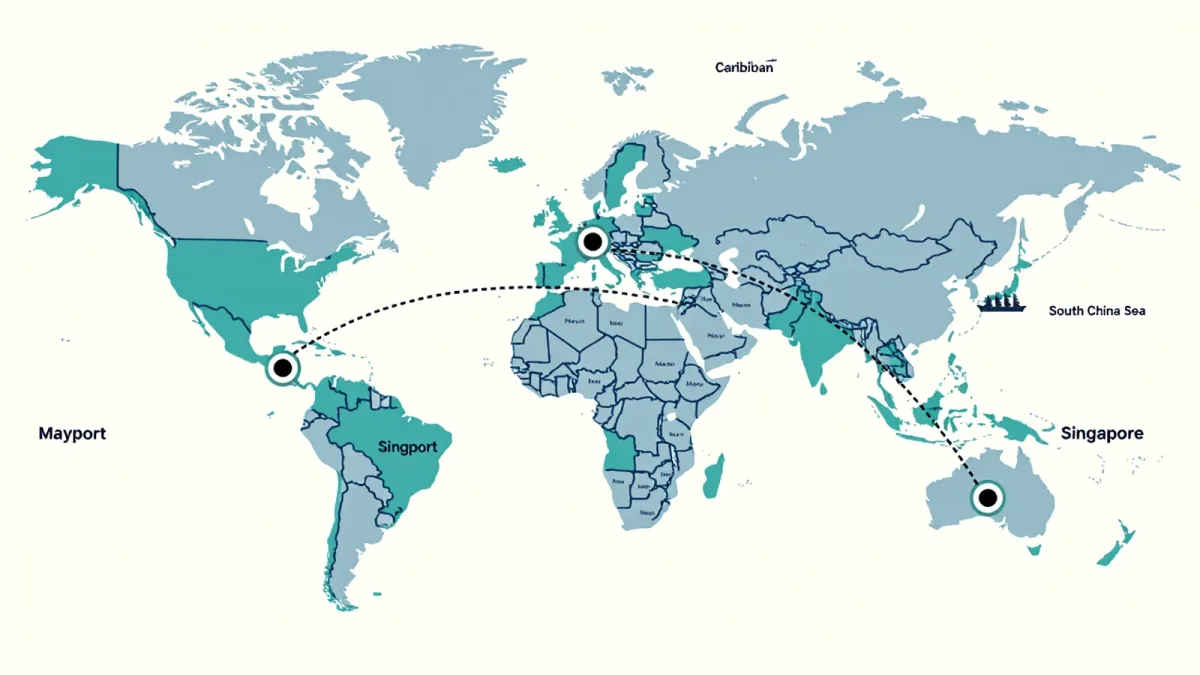
The class's documented employment pattern is forward and continuous. In 2021 the Navy established the first forward-based ESB presence in the Mediterranean, homeporting USS Hershel Woody Williams (ESB-4) at Souda Bay, Crete, to support missions in Africa and Europe under U.S. European and Africa Commands, according to Navy announcements. In the Middle East, ESBs have operated under U.S. Fifth Fleet since the class's first years, where USS Lewis B. Puller (ESB-3) conducted the class's earliest deployments supporting special operations and theater security missions. The ships' shallow operational profile, large flight decks, and boat capacity made them the Navy's platform of choice for persistent, low-intensity presence missions that would otherwise consume a destroyer or amphibious ship, a rationale Navy officials stated repeatedly in testimony and announcements through the 2020s. Unlike most fleet ships, ESBs rotate crews while remaining forward, keeping hulls on station for years at a time.
What missions do the ships perform in practice?
Documented missions fall into four groups. First, special operations support: the class was conceived as an afloat staging base for special operations forces, with berthing, boat launch and recovery, and aviation support, and this remains the design mission in Navy fact files. Second, counter-mine and unmanned systems support: ESBs have hosted mine countermeasures helicopters and unmanned surface and underwater systems in Middle East operations, documented in Fifth Fleet announcements. Third, cooperation and security missions: the Mediterranean-based hull supports partner-nation training in Africa and Europe, documented in Navy and Africa Command releases. Fourth, crisis response and humanitarian support, for which the class's berthing and flight deck suit it, though large-scale documented use in this role remained limited through 2024. The common thread in Navy descriptions is persistence: the ESB stays on station at low cost while more expensive combatants rotate through.
Why does the ESB program matter for the wider fleet?
The program is the Navy's clearest documented example of a force multiplied by low-cost hulls: six ships, built on a commercial tanker hull at a commercial yard, providing persistent presence that would otherwise be requested from carriers, amphibs, or destroyers. Navy shipbuilding plans of the 2020s kept the class at its current size without major expansion, and the ships' hybrid crewing model, blending Navy command with Military Sealift Command civilian mariners, has been cited in Navy workforce discussions as a template for auxiliary programs. For readers tracking fleet structure in 2026, the ESB line is the fleet's most stable: a fixed class of six, forward homeported, with employment set by the geographic combatant commands rather than by numbered fleet surge requirements.