The Navy's ocean surveillance fleet consists of a small number of specialized ships designated T-AGOS, operated by the Military Sealift Command with civilian crews and configured around one mission: towing long passive sonar arrays that listen for submarines across entire ocean basins. As of 2024 the force comprised four Victorious-class ships and the larger Impeccable, the sole ship of her class, according to Naval Vessel Register data and Military Sealift Command ship listings. The category's name spells out its function: Auxiliary General Ocean Surveillance. These ships rarely appear in deployment announcements, yet the acoustic data they collect feeds the Navy's integrated undersea surveillance architecture and supports the anti-submarine mission of the attack submarine and maritime patrol forces. This guide explains the ships, their sensor system, and how they operate.
What are the T-AGOS ships, and how many are in service?
Five ocean surveillance ships were in service as of 2024: USNS Victorious (T-AGOS-19), USNS Effective (T-AGOS-20), USNS Relevant (T-AGOS-21), and USNS Loyal (T-AGOS-22) of the Victorious class, plus USNS Impeccable (T-AGOS-23), according to Naval Vessel Register data and Military Sealift Command listings. The Victorious class, built in the late 1980s and early 1990s, displaces roughly 3,400 tons and carries a small crew of civilian mariners under the Special Missions Program of the Military Sealift Command. Impeccable, delivered in the early 2000s, is larger, at roughly 5,300 tons, and incorporates an improved version of the class's surveillance suite, according to Navy descriptions. The ships' names follow the category's tradition of single-word adjectives describing the mission. The category is distinct from the Navy's oceanographic survey ships, designated T-AGS, which conduct charting and science missions rather than acoustic surveillance, though both categories are MSC-operated.
How does the towed-array surveillance mission work?
The ships operate the Surveillance Towed Array Sensor System, known by its acronym SURTASS, a long passive listening array towed kilometers behind the ship on a cable, according to Navy program descriptions. The array's length and towing depth give it acoustic advantages over hull-mounted sonar: the sensors sit far from the ship's own noise, at depths where sound propagation carries across long distances, and the towed geometry allows wide-aperture processing of low-frequency signals. Data collected by the arrays is transmitted by satellite to shore-based processing facilities, where it is analyzed and fused with other undersea surveillance data sources. The ships typically tow on station at slow speeds for days at a time, a patrol pattern that makes the mission less visible than surface deployments but continuous. The system is the mobile successor to the Cold War-era fixed undersea listening barriers, and Navy descriptions of the integrated undersea surveillance architecture place SURTASS ships alongside fixed distributed arrays and sonar-equipped aircraft as its collection layers.
Who operates the ships, and what is their command structure?
T-AGOS ships are owned by the Navy and operated by the Military Sealift Command, meaning their mariners are federal civilian employees rather than Navy sailors, according to MSC organization descriptions. The ships fall under MSC's Special Missions Program, which also operates missile-instrumentation and acoustic-survey ships. Mission tasking and the sensor system's operation involve Navy undersea warfare commands, with the acoustic program managed on the Navy side through the Navy's program executive structure for special mission systems. This split, civilian operation with Navy mission control, defines the ships' character: they are unarmed, move with no escort in normal operations, and are distinguished visually from warships by their hull color and commercial design. The same model applies across MSC's combat logistics force, and MSC's civilian mariner workforce is the Navy's documented answer to crewing ships whose missions do not require a Navy watch organization.
What has the fleet's operational history been?
The category's history frames its present. The original Stalwart-class T-AGOS ships, more than a dozen hulls built in the 1980s, deployed in numbers during the late Cold War to trail Soviet submarine activity with the first-generation towed arrays; the class was largely retired in the 1990s as the threat declined, with several hulls transferred to other navies and agencies, according to Navy historical records. The Victorious class and Impeccable represented the program's modernization into the 1990s and 2000s, with SURTASS upgrades extending detection capability into low-frequency bands. The category's most publicized moment came in March 2009, when Chinese vessels surrounded and harassed USNS Impeccable while she operated in the South China Sea, an incident the U.S. Department of Defense documented publicly at the time and which became a reference point in later discussions about surveillance operations in contested waters. Through the 2010s and 2020s the fleet's deployments have been documented chiefly through MSC ship-position reporting and Navy undersea warfare program descriptions rather than public announcements, consistent with the mission's character.
How does a T-AGOS patrol actually unfold?
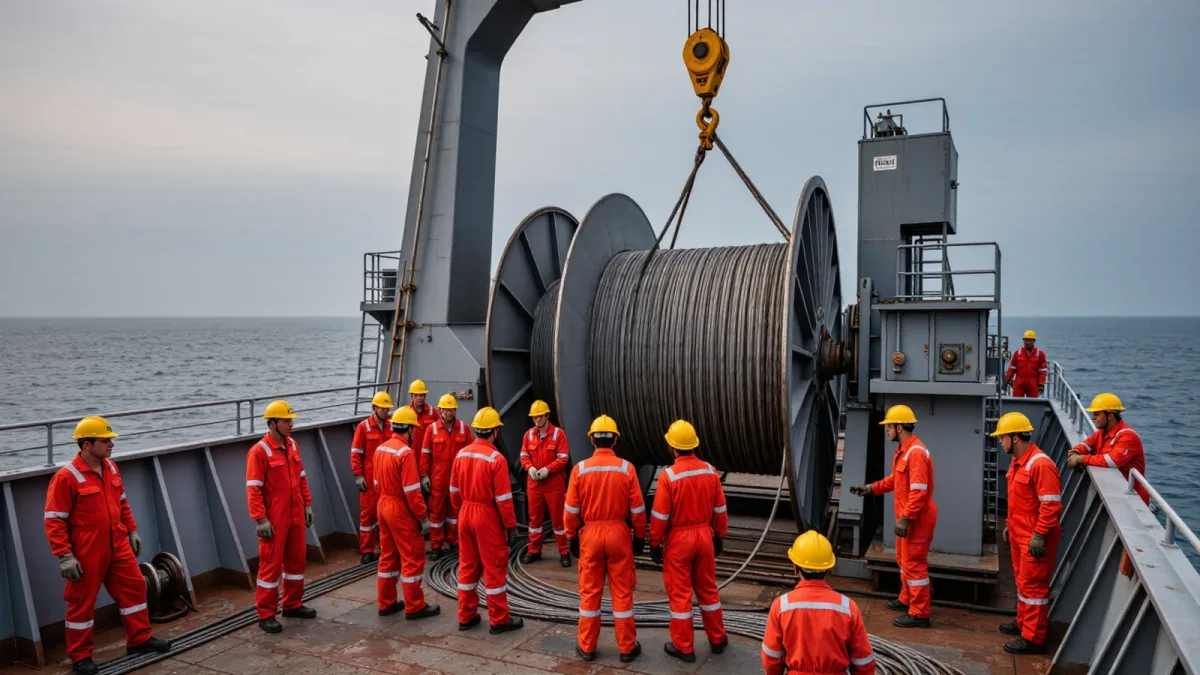
The documented operational pattern is one of long, quiet steadiness. A ship deploys to an assigned ocean area, streams its towed array from the stern, and then holds a slow towing course for days while the sensors listen, with the civilian crew managing ship evolutions and the mission system operated under Navy tasking, according to MSC and Navy program descriptions. Streaming and recovering the array is the operationally demanding part: the cable and array stream for a great distance behind the hull, and maneuvering is restricted while the system is wet. Ships rotate between on-station periods and port calls in overseas harbors suited to the mission, and MSC position reporting through the 2010s and 2020s shows the class distributed across the Pacific, the Atlantic approaches, and the seas around Japan at various periods. The patrol rhythm explains the fleet's low public profile: nothing about the mission generates announcements, and the Navy's documentation of it is largely programmatic rather than operational.
What is the future of the T-AGOS category?
Two documented pressures shape the category's future. First, age: the Victorious-class hulls are more than thirty years old, and Navy shipbuilding documents of the early 2020s addressed replacing ocean surveillance capacity as the class approaches the end of its service life, with successor-ship planning appearing in Navy auxiliary and special-mission ship documents. Second, mission growth: Navy undersea warfare strategy documents of the 2020s describe expanding anti-submarine surveillance in the Atlantic and Pacific as submarine activity increases, and the towed-array mission's data feeds directly into that architecture. The Navy's documented investments in undersea surveillance, including distributed sensor programs and unmanned systems described in naval strategy publications, complement rather than replace the T-AGOS mission, whose endurance and deep-tow acoustic capability no unmanned system replicates in the documented programs. For readers tracking the fleet, the T-AGOS force is best followed through Naval Vessel Register status changes and MSC ship listings, the two sources where its composition is officially recorded.