The Cooperative Engagement Capability, CEC, is a sensor-networking system that combines the radar measurements of every participating ship and aircraft into a single, high-quality firing picture shared in real time, so that one platform's missiles can be guided against a target tracked by another. Per Navy program history, CEC entered development in the 1980s and was fielded on the first operational ships in the 1990s, and as of May 2026 it underpins the naval integrated fire control concept known as NIFC-CA, which pairs E-2D Hawkeye aircraft with Aegis ships firing the Standard Missile-6 at targets beyond the ship's own radar horizon.
What problem does CEC solve?
Radar has a horizon problem. A ship's radar sits roughly 30 meters above the sea, and Earth's curvature hides low-flying anti-ship missiles until they are close; an aircraft radar at 25,000 feet sees the same target many times farther away. Before CEC, each unit fought its own sensors: an airborne early warning plane could radio a contact, but the receiving ship could not fire a missile at track quality data secondhand, because fire control demands measurement accuracy and update rates far beyond what a tactical datalink message carries.
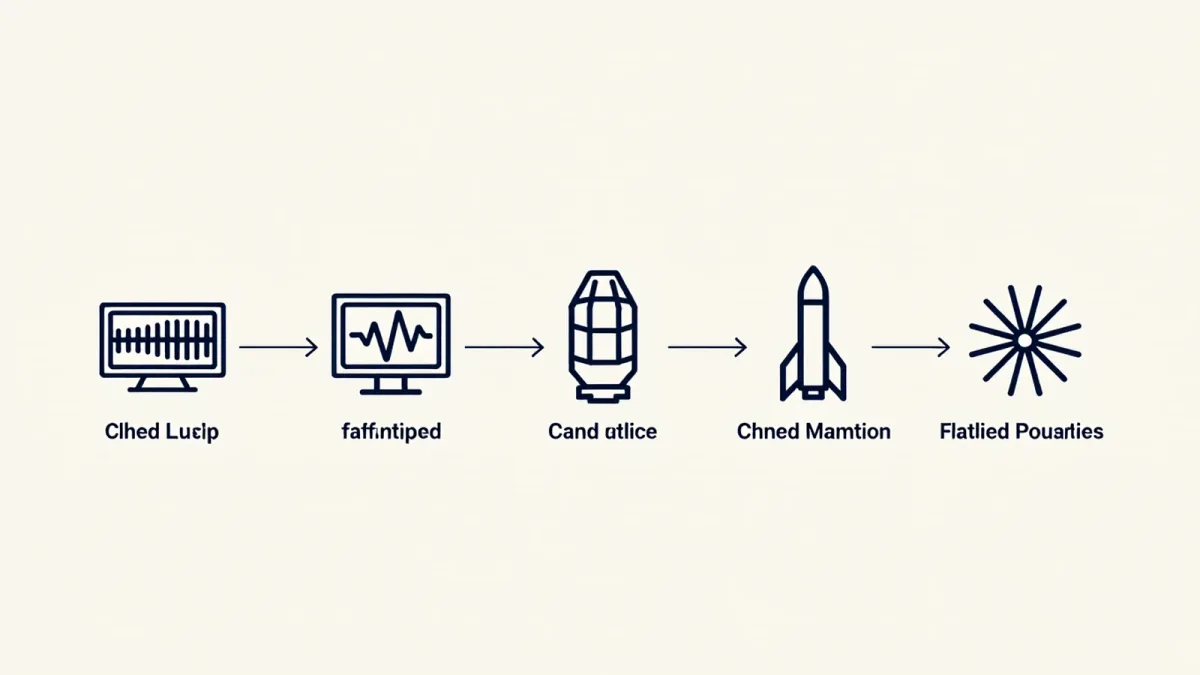
CEC closes that gap. Instead of exchanging processed tracks, participating platforms exchange raw radar measurements, and each node's processor fuses them into a composite track whose quality approaches that of a sensor with line of sight. Per Johns Hopkins Applied Physics Laboratory descriptions of the system it developed with the Navy, the result is a force-level picture in which every ship sees the same target state at the same moment, accurate enough to guide a missile.
How does the data chain work?
Three technical pieces make the composite track possible, per published APL and Navy descriptions.
- High-rate data distribution. CEC transmits sensor measurements over a wideband line-of-sight data link between participants, at rates far exceeding traditional tactical datalinks, so the picture does not lag the engagement.
- Measurement-level fusion. The receiving processors align each radar return in a common grid, resolve whose measurements describe which object, and combine them, rather than voting between finished tracks from different ships.
- Gridlock calibration. Before operations, the network precisely registers each participant's own radar alignment against the others, so that small pointing errors do not smear the composite picture at long range.
A ship with CEC receives the composite picture and can engage from it even when its own radar has no contact, a mode the Navy calls engaging on remote data, and it can guide its own missile using another platform's terminal-quality track, remote engagement.
What is NIFC-CA and how does it use CEC?
The Naval Integrated Fire Control-Counter Air, NIFC-CA, is the operational concept built on top of CEC. In the variant fielded since the mid-2010s, per Navy announcements of initial operational milestones in 2015-2016, an E-2D Advanced Hawkeye tracks a low-flying cruise missile far beyond a destroyer's radar horizon, CEC passes those measurements to the ship, and the ship launches a Standard Missile-6 that is guided toward the remote track and updates against the aircraft's data in flight. The destroyer shoots at a target it cannot see; the Hawkeye supplies the eyes.
Navy testing in 2016 added a further sensor: an F-35 aircraft acting as the airborne tracker for an SM-6 engagement, per service test statements from that year. Each additional sensor type widens the geometry an adversary must defeat, which is the strategic point of the concept, sometimes summarized as engaging the archer before the arrow arrives.
What carries CEC today?
As of May 2026, per Navy and Congressional Research Service reporting, CEC is installed on U.S. Navy cruisers, destroyers, aircraft carriers, and amphibious ships, on E-2D aircraft, and in Aegis Ashore sites, with allied navies including Australia, Japan, and others procuring the system for their own Aegis-equipped fleets. Fielding is incremental by ship class and baseline, and not every participating platform can engage on remote data; the capability depends on the host combat system's software as much as on the CEC hardware.
Cost and integration are the watch items. Per CRS reporting through 2025, each CEC installation and its combat system integration runs to tens of millions of dollars per ship class increment, and the system's bandwidth demands have driven successive hardware upgrades as the networked force grows.
What are CEC's limits?
CEC is not a substitute for range; it is a line-of-sight radio network, so the relay geometry still needs aircraft, satellites, or repeaters to connect forces over long distances. The composite track is only as good as the sensors feeding it, and heavily jammed or degraded radar inputs propagate into the shared picture, which is why the Navy pairs the system with electronic warfare hardening and disciplined sensor management. And the human is retained: engagement authority remains with the firing platform's tactical action officer, per Navy rules of engagement practice, so the network informs the shot but does not take it.
How did CEC develop?
CEC began as a research question in the 1980s: could raw radar data from separate platforms be combined in real time with enough precision to support a fire-control solution? Per Johns Hopkins Applied Physics Laboratory histories of the program, early prototypes in the late 1980s linked land-based and shipboard radars and demonstrated composite tracks of aircraft flying behind terrain, which no single sensor could hold continuously. The Navy designated it an acquisition program in the early 1990s, and the destroyer USS Kidd (DDG-993) class and the carrier USS John C. Stennis (CVN-74) participated in early operational assessment, per Navy test reporting of the period.
Fielding then proceeded by demonstration rather than decree. In 1996, per Navy announcements, an Aegis cruiser engaged a target using data from another ship's sensors, the first operational-style remote engagement, and the fleet installation campaign followed through the late 1990s and 2000s. Each new platform integration, E-2D aircraft in the 2010s, Aegis Ashore, allied ships, required combat system software work on the host, which is why CEC's spread tracks the baselines described earlier. The development pattern, research prototype, operational demonstration, incremental integration across decades, has become the reference the Navy cites for its current sensor-networking ambitions, per service program descriptions.