The Aegis Combat System is the network of radars, computers, displays, and missile launchers that lets a warship detect, track, and engage hundreds of air, surface, and ballistic targets at once. First delivered to sea aboard the cruiser USS Ticonderoga (CG-47) in January 1983, per the Navy's program history, Aegis today equips U.S. Ticonderoga-class cruisers, Arleigh Burke-class destroyers, and Aegis Ashore sites in Romania and Poland, along with allied ships in Japan, South Korea, Spain, Australia, and Norway.
What problem was Aegis built to solve?
Through the 1960s, surface ships defended themselves against aircraft with rotating search radars and point-defense missiles that had to be manually assigned target by target. A saturated raid of fast, low-flying bombers and anti-ship missiles could exhaust the track capacity of those systems before a single target was engaged. The Navy's Advanced Surface Missile System study, which became Aegis in December 1969 when the contract was awarded to RCA, was designed around one idea: automate the whole chain from detection through engagement so that reaction time collapsed to seconds.
The solution combined a fixed-panel phased-array radar with a digital computer complex that could maintain tracks on every detected object continuously rather than scanning for them in sequence. Per the Navy's historical summaries, the program chose the new SPY-1 phased array paired with the Standard Missile family, and the first operational shipboard installation went to sea on CG-47 in 1983.
How does the SPY-1 radar work?
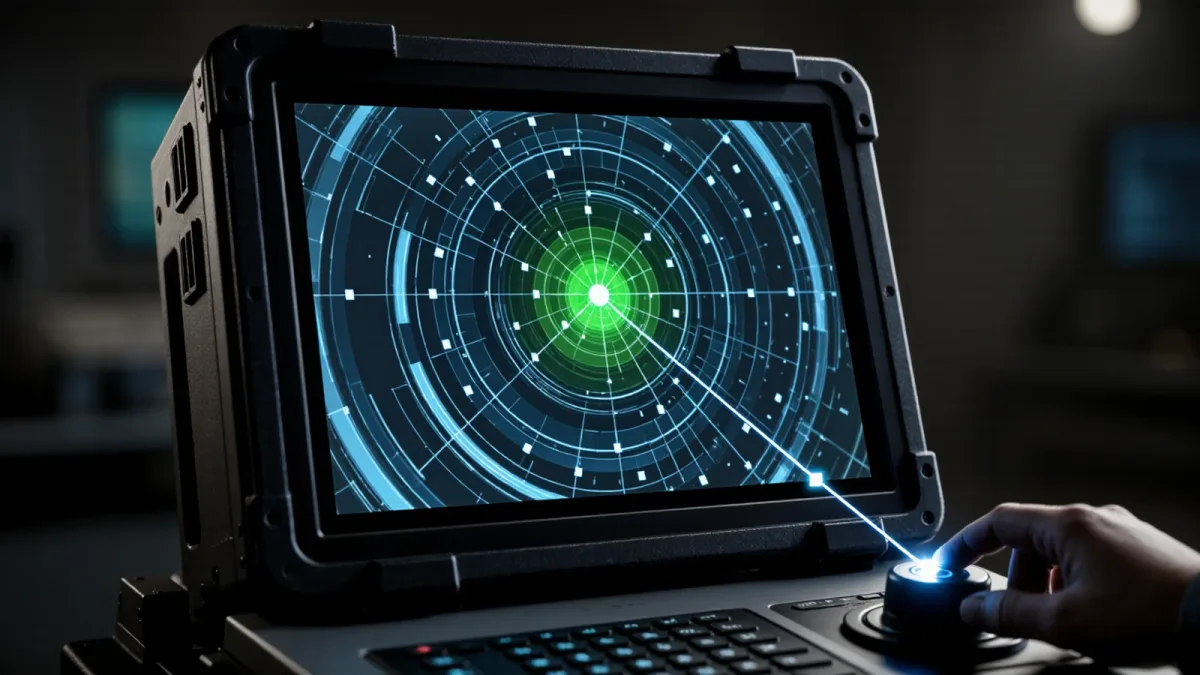
A phased-array radar steers its beam electronically. Where a conventional rotating radar physically sweeps the horizon once every few seconds, the SPY-1's four fixed octagonal panels can point pencil-thin beams anywhere in their hemispheres in microseconds. One panel can search the horizon, another can track a raid, and a third can guide a missile, all essentially simultaneously and with no moving parts in the antenna itself.
That agility is what turns radar into a weapon. Illuminating a target for a semi-active missile or providing terminal-quality track data requires holding energy on the target precisely when the interceptor is in its endgame. A mechanical radar cannot do that for many targets at once; SPY-1 can, which is why the system's defenders describe it as a fire-control radar that also happens to search.
What are Aegis baselines?
Aegis is not one configuration but a rolling series of software and hardware builds called baselines. Per Congressional Research Service reporting on the program, U.S. cruisers and destroyers carry baselines in the range of Baseline 3 through Baseline 10, with each baseline adding capability such as new processor hardware, ballistic missile defense software, and cooperative engagement of off-board sensors. Allied navies select baselines matched to their hulls and missions.
Baseline 9 and Baseline 10 are the reference points for the modern fleet because they integrate naval integrated fire control concepts, in which an Aegis ship can launch a missile using tracking data from another platform's radar. Baseline 10, fielded on Flight III Arleigh Burke destroyers fitted with the SPY-6 radar, per CRS reporting from 2023 onward, represents the transition from the SPY-1 generation to the new gallium-nitride radar family in the U.S. fleet.
How does Aegis engage a target?
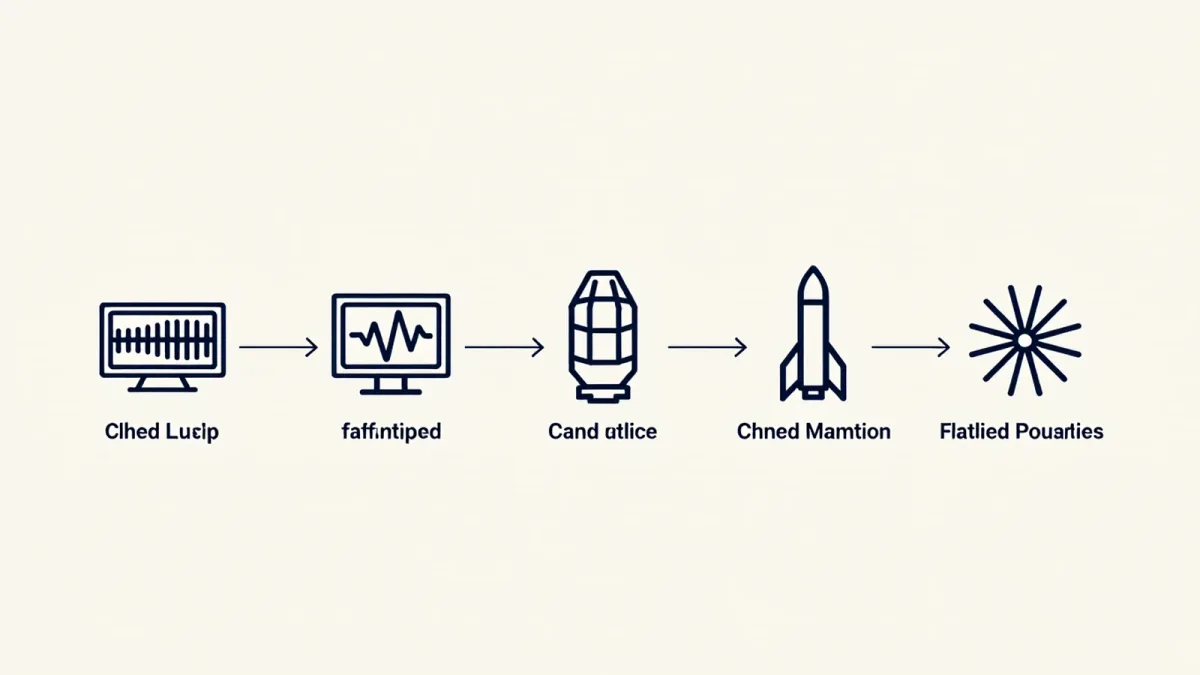
The engagement chain runs in five steps.
- Detection. SPY-1 or SPY-6 pulses the volume, and the computer complex forms and maintains tracks on everything that returns energy, filtering clutter and correlating new contacts with existing tracks.
- Threat evaluation. The system classifies each track and the tactical action officer's team assigns threat priorities under the ship's rules of engagement.
- Weapon assignment. The system matches each prioritized threat to the best available interceptor and checks launcher readiness and firing geometry.
- Launch. Missiles leave the Mk 41 vertical launch system cells on the destroyer deck; Aegis computed a fire-control solution before the missile cleared the cell.
- Guidance and endgame. The ship or an off-board sensor illuminates or tracks the target through the missile's terminal phase, and Aegis assesses the intercept and can shoot again if the target survives.
The human role concentrates in steps two and five. The system proposes; officers decide, and the doctrine of layered defense assumes some shots miss, which is why Aegis ships operate as area-defense assets rather than single-ship duels.
What role does Aegis play in ballistic missile defense?
Since the early 2000s, Aegis ships fitted with the ballistic missile defense baseline have tracked and intercepted short- and medium-range ballistic missiles using the Standard Missile-3, exo-atmospheric interceptor, and defended against endo-atmospheric threats with SM-2 and SM-6. Per Congressional Research Service reporting through 2025, dozens of U.S. destroyers and cruisers carry the BMD mission, and Aegis Ashore installations in Romania, operational since 2016, and under construction in Poland extend the same system to land.
That dual mission has made Aegis the most exportable piece of U.S. missile defense architecture. Japan's Kongo-class and Atago-class destroyers, South Korea's Sejong the Great-class ships, and Spain's F-100 frigates all run national variants of the system, per Congressional Research Service and Navy program reporting, which also sustains the industrial and software base behind the U.S. fleet's own upgrades.
What does an Aegis ship's crew do during an engagement?
The automation in Aegis changes rather than removes the human workload. Per Navy training doctrine descriptions, the combat direction center runs watch teams under a tactical action officer, who owns the decision to fire even in a raid measured in seconds. The system nominates weapons and solutions; evaluators confirm classification, the weapons liaison officer confirms launcher and missile readiness, and the tactical action officer or a designated firing authority authorizes the shoot. In a heavy raid, doctrine expects the ship to operate in a semi-automatic mode in which pre-authorized engagement rules allow the system to fire without a per-shot decision, but that authority is granted by commanders in writing before the raid, not seized by the software.
Training is the other half of the system. Per Navy descriptions of its Aegis training pipeline, operators progress through schoolhouse courses and team trainers that inject raids, decoys, and failures into realistic sessions, and ships certify in exercises that score detection-to-engagement timelines. Program reporting on the Aegis modernization effort through 2025 has repeatedly identified trained crew proficiency, not hardware, as the pacing factor in combat system performance, which is why baseline upgrades arrive bundled with training pipeline changes rather than software alone.