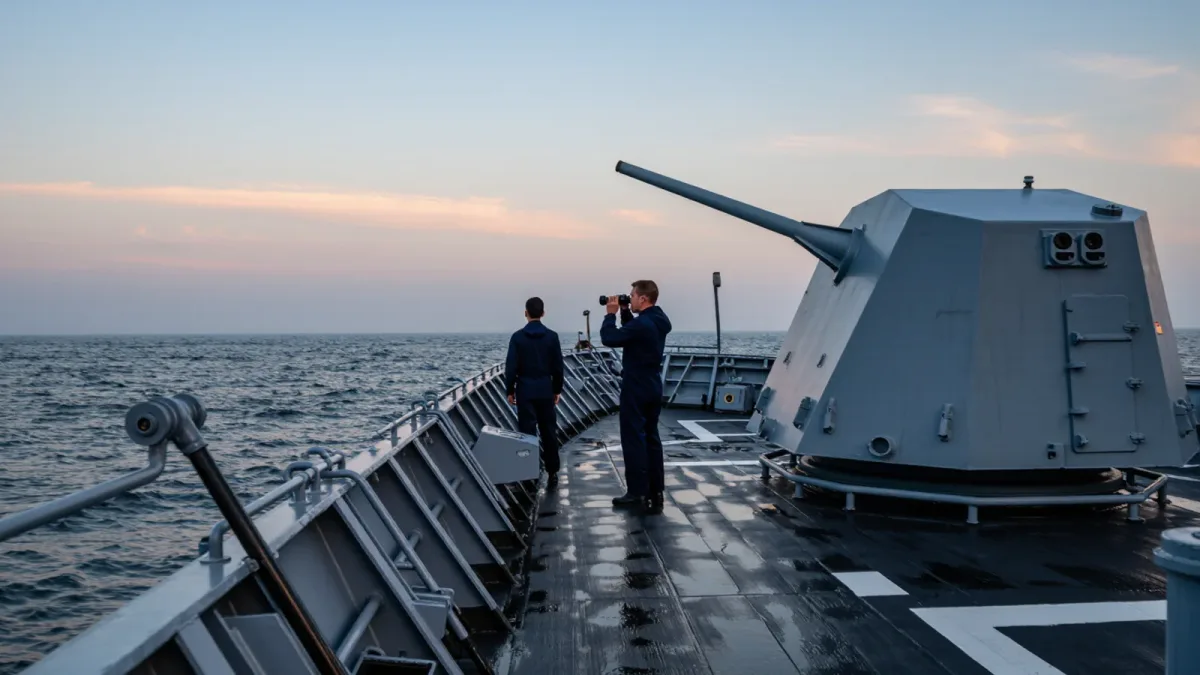
Shipboard laser weapons concentrate electrical power into a beam of light that can burn through small boat hulls, disable drone airframes, or dazzle surveillance optics. As of December 2025, the U.S. Navy has fielded two families of the technology on surface combatants: the Optical Dazzling Interceptor, known as ODIN, and the High Energy Laser with Integrated Optical-dazzler and Surveillance, known as HELIOS, which the Navy has described as a roughly 60-kilowatt-class system installed on the Arleigh Burke-class destroyer USS Preble (DDG-88).
How does a shipboard laser weapon actually work?
A directed energy weapon is not a bolt of light in the cinematic sense. It is a steady beam of infrared energy, generated by an electrically pumped solid-state laser, focused through a beam director on the ship's superstructure. The beam director keeps the spot on one point of the target for a fraction of a second to several seconds, and that dwell time is what defeats the target: the surface heats, the material weakens, and a plastic drone airframe burns or a small boat engine fails.
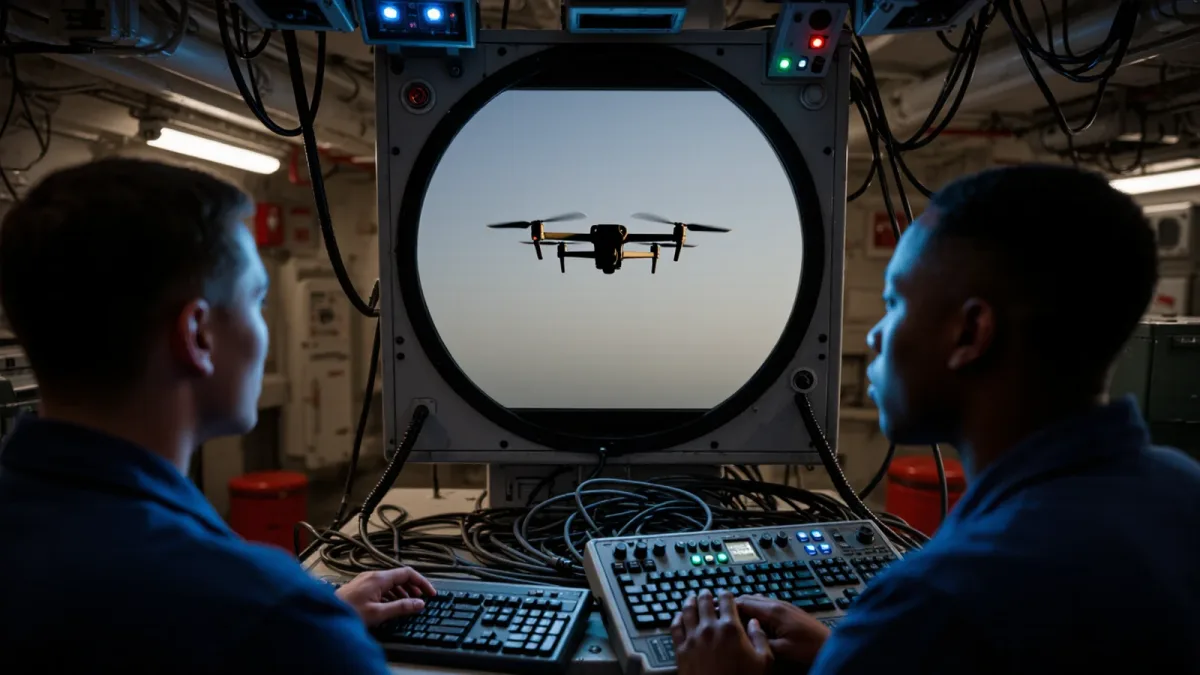
The physics that matters most is not raw power but beam quality and stabilization. A rolling deck, salt haze, and humidity all smear the beam. That is why the Navy's Office of Naval Research has spent two decades on solid-state laser maturation before fielding systems, and why every shipboard laser is married to an optical surveillance or tracking suite. The laser is only half the weapon; the other half is a fire-control camera that can hold a spot on a target moving at closing speeds that can exceed several hundred meters per second in the drone case.
Per the Office of Naval Research's published program descriptions, the laser weapon chain runs: detect with radar, hand off to the electro-optical tracker, slew the beam director, fire, and hold until the effect is achieved. There is no magazine in the traditional sense. The limit is electrical power and thermal management, which is why laser systems have gone to flight-arleigh destroyers with margin in their electrical plants rather than to every hull in the fleet.
What is HELIOS and what can it do?
HELIOS, for High Energy Laser with Integrated Optical-dazzler and Surveillance, is a Lockheed Martin-built system the Navy contracted for in 2018 under a surface navy directed energy program managed through Naval Sea Systems Command. Its three functions are in the name: a high-energy laser for defeat of small boats and unmanned aerial systems, an optical dazzler to degrade adversary surveillance sensors, and a long-range surveillance capability through its own optics.
The Navy has publicly described HELIOS as operating at the 60-kilowatt class, with power scalable in future increments. The system was installed on USS Preble (DDG-88) during a 2021-2022 availability, and per the Navy's 2024 announcements Preble deployed to the Pacific in 2024 as part of a carrier strike group with HELIOS fitted, the first operational deployment of the system. Unlike a missile, a laser engagement costs electricity rather than a round of ammunition, which is the core of the Navy's cost-per-kill argument for the technology against cheap drones.
HELIOS also feeds the fleet's learning curve. Each deployment generates data on how the beam behaves in tropical humidity, how often the system can fire before thermal limits force a pause, and how crews integrate a new weapon into air defense procedures. The Navy has not published engagement tallies from these deployments, and claims about combat results should be treated with caution absent an official statement.
What is ODIN and how does it differ?
ODIN, the Optical Dazzling Interceptor, is a lower-power system with a different mission. Rather than burning through targets, it projects energy that blinds or degrades electro-optical sensors, including the imaging systems on unmanned aircraft. Per Navy budget documents from fiscal year 2020 onward, ODIN units were installed on Arleigh Burke-class destroyers beginning in 2020, with the fleet growing to a small number of hulls in the years since.
The distinction matters for how the systems are used. A dazzler does not need to dwell on a hull until it fails; it needs to deny an adversary's camera a usable picture, which requires less power and offers shorter engagement timelines. In practice the Navy treats the two families as complementary: ODIN addresses the sensor problem, HELIOS the hard-kill problem, and both generate the fleet experience that the Navy's directed energy roadmap depends on.
What came before HELIOS and ODIN?
The lineage runs through the Laser Weapon System, or LaWS, a 30-kilowatt experimental system built from commercial fiber laser modules. Per the Office of Naval Research, LaWS was installed on the amphibious transport dock USS Ponce (LPD-15) in 2014 while the ship served in the Persian Gulf, where crews conducted the first at-sea demonstrations of a shipboard laser against small boats and drone targets. Ponce is a useful benchmark because the system worked, but also because the Navy drew the practical lesson: 30 kilowatts defeats drones in favorable conditions but is not enough power margin for all-weather air defense.
That lesson shaped the follow-on Solid State Laser Technology Maturation effort, which scaled fiber laser architectures toward the 60-kilowatt class and beyond, and set the stage for HELIOS. In parallel, the Navy has continued laboratory and land-based testing of higher-power systems, with budget documents through fiscal year 2025 describing work toward 150-kilowatt and higher classes for future destroyers and amphibious ships.
Why lasers, and what are the limits?
The case for shipboard lasers rests on magazine depth and cost. A guided interceptor costs a multiple of the drone it destroys, while a laser shot costs fuel-cycle electricity. Against the sort of small unmanned aircraft and fast attack craft that have driven naval planning since the Red Sea drone and missile attacks of 2023 and 2024, that arithmetic is the argument.
The limits are equally clear. Lasers need line of sight, lose effectiveness in fog, heavy rain, and sea spray, and currently lack the power to defeat anti-ship cruise missiles or ballistic threats. Every kilowatt directed at a target competes with propulsion and combat system loads on the ship's electrical plant. As of December 2025, the Navy's position, per its budget submissions, is that lasers supplement rather than replace missiles, handling the cheap, slow end of the threat spectrum so that interceptors remain for the fast and lethal end.