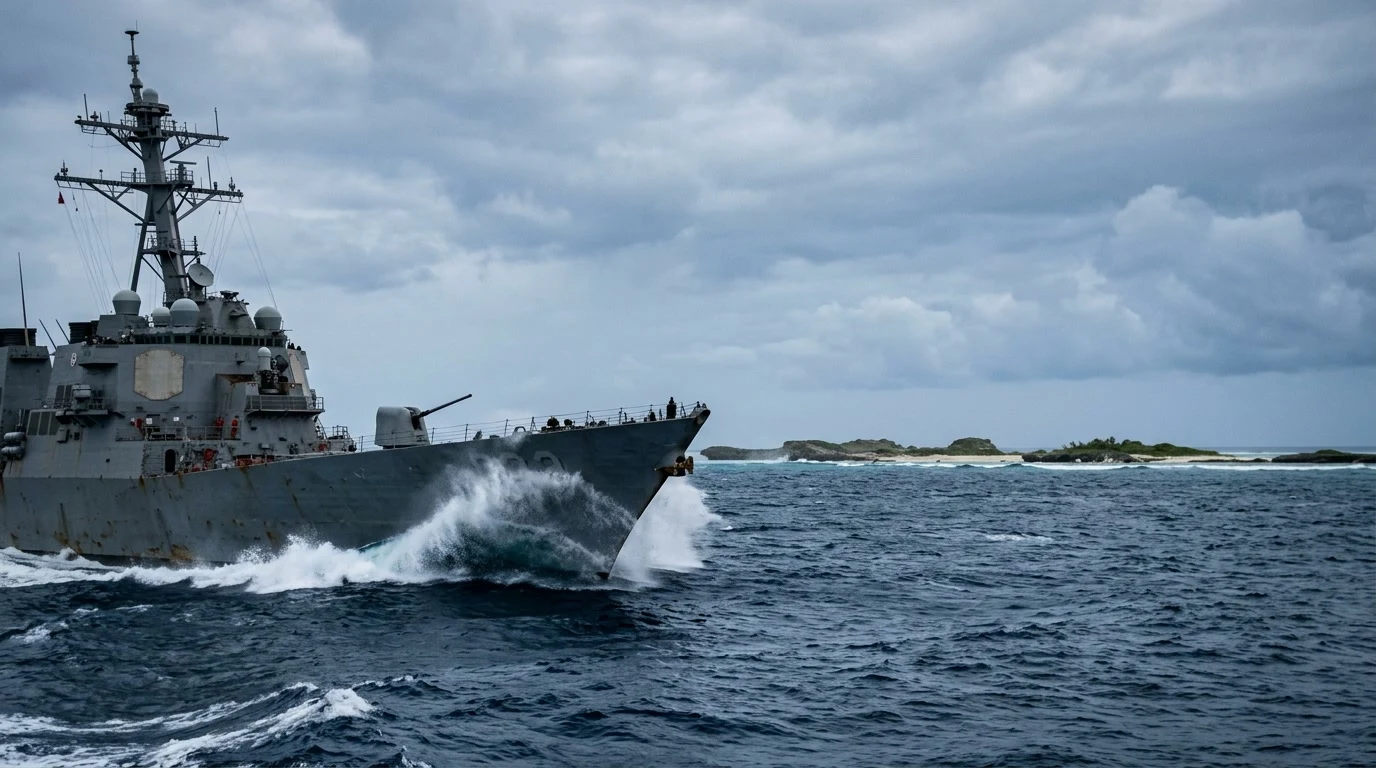
The Excess Defense Articles (EDA) program, authorized by Section 516 of the Foreign Assistance Act of 1961 and implemented by the Defense Security Cooperation Agency, allows the United States to transfer surplus defense equipment, including retired warships, to allied and partner governments on a grant basis or by sale. Hulls in the reserve fleet or awaiting disposal are reviewed for allied demand, notified to Congress, and transferred as-is, where-is, with the recipient covering refurbishment and delivery. Naval transfers under this authority have equipped partner navies with frigates, cutters, and amphibious ships for decades, and DSCA's published records document each case after notification.
Because the program operates under statutes, regulations, and case-by-case determinations, this article is informational; naval-pages.com publishes information, not legal advice.
What qualifies a ship as an excess defense article?
The process begins inside the Department of Defense, not with the recipient. A service declares an item excess when it no longer has a U.S. military requirement, and the item must still be usable or restorable for the proposed end use. For ships, candidates typically come from the reserve fleets and the disposal lists maintained by Naval Sea Systems Command. Determinations then run through the EDA screening sequence: the item is offered first to U.S. agencies, then screened for foreign military sales demand, and only after demand is established does DSCA seek the statutory determinations required by law, including that the transfer serves U.S. national security interests and that U.S. forces suffer no material adverse effect. Items that fail the process are demilitarized and disposed of domestically instead.
How does a transfer move through Congress?
EDA is one of the security cooperation authorities that requires advance congressional notification before delivery. Under the Foreign Assistance Act framework, DSCA notifies the relevant congressional committees of proposed transfers, with the notification period set by the value and nature of the article; major naval vessels receive the longest review window. The notification letters, published on DSCA's website after formal transmittal, state the recipient, the item, the estimated value, and the justification. Committees can place holds that stop a transfer, and appropriations language can attach conditions such as certification of the recipient's conduct. No ship sails under EDA authority until the notification clock has run and funding arrangements, typically a grant of the article itself with recipient-paid reactivation, are settled.
What does the recipient country actually receive?
The ship itself is the grant or sale item; nearly everything else costs the recipient money. Transfers are made as-is, where-is, meaning the hull arrives in its then-current material condition, usually after years of layup. The recipient funds reactivation work, often performed at U.S. shipyards, along with crew training, logistics establishment, spare parts, and technical data. Standard terms require end-use commitments: the ship is to be used for legitimate defense purposes, not retransferred without U.S. consent, and returned to U.S. control for disposal at the end of its service if requested. These conditions, written into the transfer documentation under the Arms Export Control Act framework, give the United States continuing visibility into how the hull serves and whether it has been passed onward.
Which naval transfers is the program known for?
EDA has shaped several partner fleets. The most cited cases involve frigates and destroyers.
- Knox-class frigates, transferred to several navies in the 1990s, put former U.S. escort hulls into allied service across the Pacific and Mediterranean.
- Oliver Hazard Perry-class frigates, declared excess as the U.S. Navy retired them, were transferred to partners including Poland, Turkey, Pakistan, and Bahrain through grant and sale combinations documented in DSCA notifications from the 2000s onward.
- Kidd-class destroyers sold to Taiwan under a 2000-2003 approval sequence became that navy's largest surface combatants for two decades, illustrating the sale variant of EDA-adjacent transfers.
- Former U.S. Coast Guard high-endurance cutters passed to allied coast guards and navies, extending hull lives by fifteen years or more in some cases.
DSCA's notification archive is the authoritative record of each case, including values and dates.
What are the benefits and the criticisms?
Supporters frame EDA as alliance maintenance at low marginal cost. A hull already built and paid for extends partner capability, interoperability with U.S. forces improves because the equipment matches U.S. systems, and the recipient's reactivation work sustains U.S. shipyard industrial capacity. Critics raise three recurring concerns. First, the offer of free hardware can distort partner procurement planning, deterring new builds. Second, as-is hulls impose heavy lifetime sustainment costs on recipients with limited budgets, and some transferred vessels have spent years non-operational after delivery. Third, oversight groups have noted that transfer decisions sometimes serve disposal convenience as much as strategy, since alternative disposal, scrapping, carries its own environmental and cost burdens. GAO reviews of the EDA program have examined these trade-offs and are available through gao.gov.
How does EDA differ from other transfer authorities?
EDA is distinct from the standard Foreign Military Sales program, in which a partner buys new or existing equipment at full value, and from the Drawdown authority used in emergencies. The distinguishing feature is that the article is surplus: the United States gives up equipment it no longer needs, so the transaction is valued at the article's net book value rather than replacement cost. For ships, the difference is enormous, since a retired frigate's remaining value is a fraction of its original construction cost. The 516 grant authority and EDA sales both sit inside the same screening and notification architecture, and DSCA's Security Assistance Management Manual, published at samm.dsca.mil, walks through the mechanics step by step.