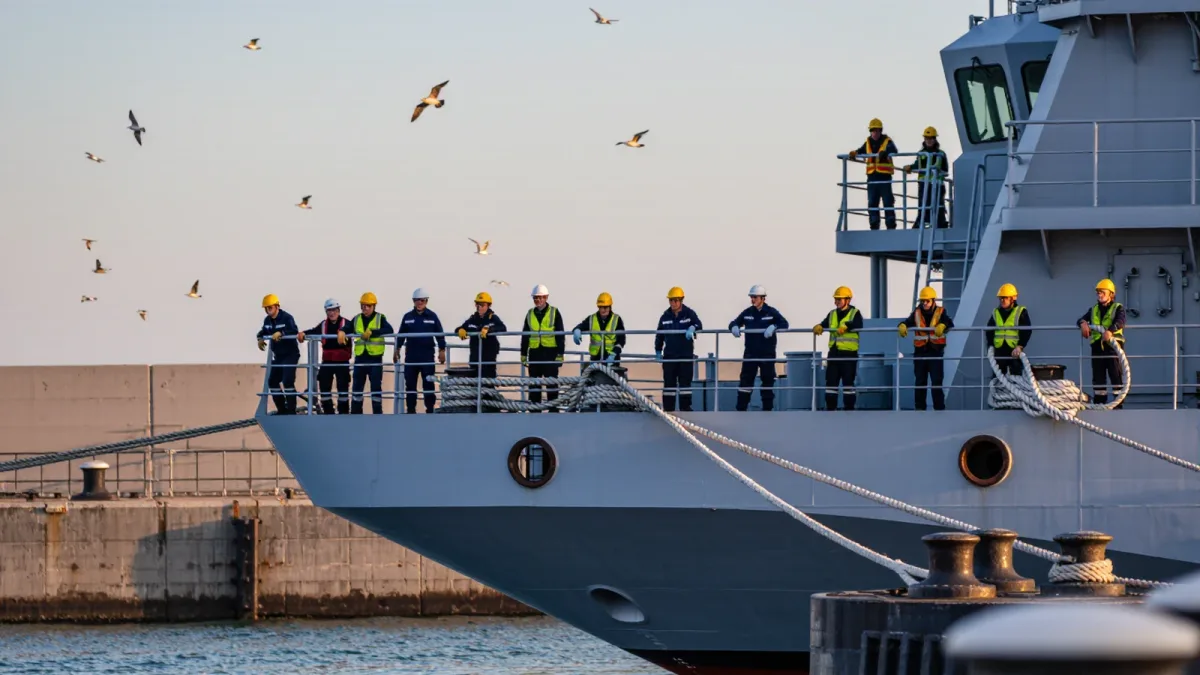
LPD Flight II is the current production standard of the San Antonio-class amphibious transport dock program: hulls designated LPD-29 and beyond, built at Huntington Ingalls Industries' Ingalls Shipbuilding in Pascagoula, Mississippi, and intended to replace the Navy's retiring Whidbey Island- and Harpers Ferry-class dock landing ships. According to Navy budget materials published through 2025, the long-range plan identified 13 Flight II hulls, with LPD-29 delivered to the Navy in 2024 and commissioned that September as Richard M. McCool Jr., and LPD-30, LPD-31, and LPD-32 in construction under awarded contracts. The class carries Marines, their landing craft, and their aviation, making it the load-carrying centerpiece of the amphibious fleet's surface connector missions.
What is an LPD, and what does it carry?
The San Antonio class is designed around a single idea stated in Navy fact sheets through 2025: carry a Marine expeditionary unit's equipment and move it ashore. The ship transports landing craft in a well deck flooded at the stern to launch and recover amphibious vehicles and air-cushion landing craft, and it operates helicopters and the Osprey tiltrotor from a flight deck and hangar. Crewed by several hundred sailors and embarking hundreds of Marines, the class functions as the connector hub of an amphibious ready group, sitting between the large-deck LHA carriers that carry the aviation package and the destroyers and frigates that provide escort. Navy descriptions emphasize the class's role as the most survivable amphibious transport in the fleet's inventory, with the command facilities to lead small amphibious operations.
What makes Flight II different from Flight I?
Flight II hulls are modified Flight I designs rather than a new class, per Navy program statements through 2025. The principal change is the radar: Flight II ships fit the Enterprise Air Surveillance Radar, a rotating variant of the SPY-6 family, in place of the older air-search radar fitted in earlier hulls, with associated combat system and electrical changes. Navy materials also describe modifications to the mast, topside arrangement, and internal spaces, along with updated command-and-control and electronic warfare provisions. The well deck and the ship's core transport mission carry over unchanged — a point of deliberate continuity, since the class's early hulls experienced years of post-delivery correction and the Navy has described Flight II as incorporating lessons learned from that history into the baseline before construction. Flight II is also designated as the LSD replacement: as the Whidbey Island and Harpers Ferry classes retire through the 2020s and 2030s, the Flight II hulls take over the surface connector mission those ships performed.
How many ships are planned, and where does the line stand?
As of the Navy's budget materials and long-range shipbuilding plans published through 2025, the program of record for Flight II stood at 13 hulls, continuing the class toward LPD-41 in the planning horizon. The delivery record through mid-2025: LPD-29, Richard M. McCool Jr., delivered and commissioned in 2024; LPD-30 in outfitting and test at Pascagoula; LPD-31 and LPD-32 in fabrication under contracts awarded earlier in the decade. Ingalls is the sole builder, and the production rhythm follows the amphibious budget: one to two San Antonio hulls funded per year in most recent plans, with block fabrication beginning years ahead of launch. Earlier hulls of the class were named for cities; Congress broke that pattern with LPD-29's namesake, a Medal of Honor recipient from the Okinawa campaign, and subsequent hull naming followed congressional announcements rather than the older convention.
What has the program's track record been?
The San Antonio class entered service with a troubled start and a strong recovery, a record documented in Navy and Government Accountability Office reporting through the 2010s and 2020s. The first hulls, delivered in the mid-2000s, required extensive post-delivery availability work for years — hull coatings, machinery, and crew habitability among the recurring issues — and GAO reviews of that era criticized the acquisition strategy for approving ships before testing was complete. Later Flight I hulls and the Flight II build standard incorporated those corrections, and Navy delivery statements of the 2020s describe progressively cleaner deliveries, culminating in LPD-29's acceptance. The program is now cited in Navy testimony as an example of a class that matured through production, though the cost of early instability — measured in decades of post-delivery work — remains part of the record that oversight reports carry forward.
How does a well deck work?
The class's defining feature deserves a plain-language explanation, since it is the capability the LSD replacement mission preserves. The well deck is an open bay at the stern, open to the sea when the ship ballasts down; per Navy fact sheets through 2025, the San Antonio class can flood the deck and launch or recover landing craft, including air-cushion landing craft that carry vehicles and equipment directly to a beach. Launch and recovery require the ship to hold a steady course and trim while the bay takes on thousands of tons of water, a seamanship evolution the class's crews train on repeatedly. Above the well deck, the flight deck handles helicopter and tiltrotor operations, so the ship can push a landing force ashore by sea and air at the same time. That combination is what no other hull in the amphibious inventory duplicates in the same configuration.
How does the program fit the amphibious debate?
The Flight II line is the concrete answer to a force-structure question that Navy and Marine Corps leadership of the mid-2020s framed repeatedly: the amphibious fleet needed 31 ships by their joint statement, and the LSD classes were retiring without a purpose-built replacement. Congressional Research Service reports and testimony through 2025 described the decision history — the Navy considered a new LSD replacement design, then settled on continuing the San Antonio line as Flight II, trading a new design's risk for the production line's continuity. The same documents record the constraint: at the amphibious budget's funding pace, Flight II deliveries replace retiring LSD tonnage slowly, keeping the amphibious battle force below the stated 31-ship requirement through the 2020s. That arithmetic is why each year's budget submission amphibious lines draw congressional attention.
What comes after Flight II?
Navy planning documents through 2025 carried a next-generation amphibious ship study — a design effort intended to follow the class and eventually replace remaining Flight I hulls — but as of those documents the program had not produced a contracted design, and the Flight II line remained the funded, building reality. For readers tracking the program, the dated indicators are straightforward: delivery and commissioning announcements from Ingalls and the Navy for LPD-30 and successive hulls, the amphibious procurement lines in each annual budget submission, and the fleet counts in Navy and Marine Corps testimony measuring the 31-ship requirement. Everything else — follow-on designs, names, and hull numbers beyond the funded plans — remains planning material rather than program fact.