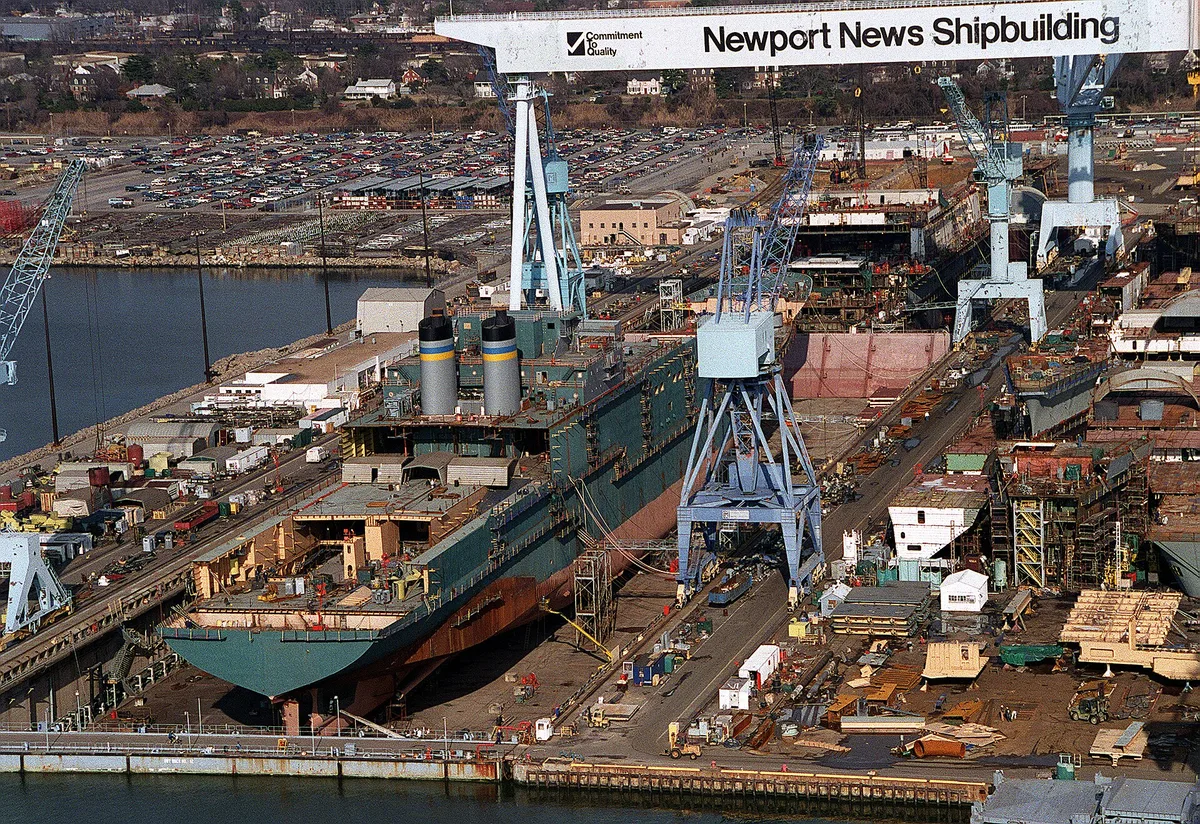
Modular shipbuilding is the practice of building a warship in large, pre-fitted sections called blocks or modules, then joining them at the yard. The approach exists to cut construction time and cost: work on machinery, piping and cabling happens inside each block while other blocks are still being built, so hundreds of trades work in parallel instead of in sequence. Most modern naval yards now build this way as a matter of course.
The logic is the same one that reshaped car plants and aircraft lines. According to Wikipedia's overview of modular design, the principle subdivides a system into smaller parts that can be independently created, modified, replaced or exchanged, using well-defined interfaces between them. Applied to a hull, that means a machinery room, a superstructure section and a bow section can each be finished on their own schedule, then bolted and welded into one ship. For more on how a finished ship moves from first steel to service, see this primer on how a navy ship moves from keel laying to commissioning.
This guide explains what a module actually is, why navies adopted the method, where the savings come from, and what the approach costs in complexity. It is written from general, durable knowledge of the industry; no fleet numbers or program dates appear here because no sourced pack supports them.
What counts as a module in a warship?
A module is a self-contained, standardized unit built as one piece. In shipbuilding terms, that usually means a structural block — a slice of hull, a deckhouse, an engine room — that leaves the shop with equipment already installed inside it. The Cambridge Dictionary's entry on modular design captures the core idea through its corpus examples: standardized products made of interchangeable or modular parts are the key elements of mass production, and economies of scale follow from them.
Two levels of modularity matter in naval work. The first is structural: the ship is divided into blocks for construction efficiency, but the blocks are welded together and never meant to come apart. The second is functional: whole systems, such as a weapon module or a sensor container, are designed to be swapped during the ship's life. Dictionary.com's definition of modular — composed of standardized units for easy construction or flexible arrangement — covers both senses, and the second is where navies see the longer-term payoff.
Why did navies move away from building hulls in place?
Traditional shipbuilding assembled a hull on the slipway and fitted it out afterward. That sequence creates a bottleneck: thousands of workers crowd into one hull, one compartment at a time, once the structure is closed. Anything that delays structural work delays every trade behind it.
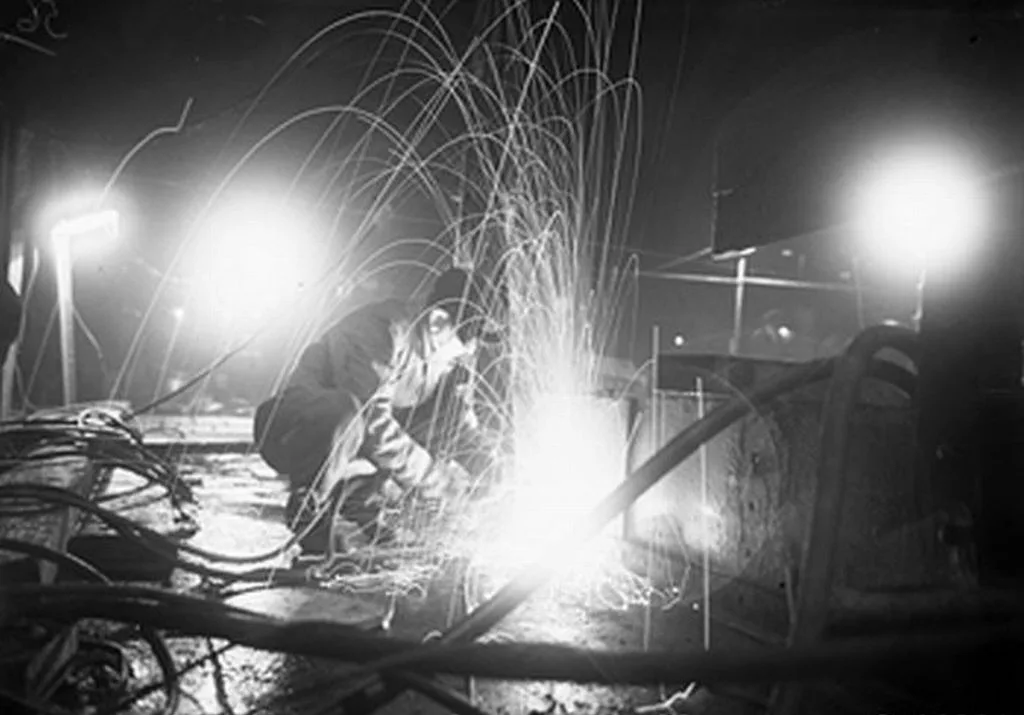
Modular construction breaks that sequence. A yard builds dozens of blocks simultaneously across its shops and halls. Each block arrives at the assembly line with its piping runs, cableways, insulation and much of its equipment already in place. The final welds close the hull, and the outfitting work that once took years aboard the ship is largely finished before the blocks ever meet. The welding that joins those blocks is itself a critical technology; this explainer on shipbuilding welding and why hull welds matter covers the quality issues involved.
Parallel work is the whole point. Wikipedia's treatment of modular design notes that when modules are standardized, the system carries fewer unique parts, which reduces production time and eases inventory management. A yard that builds two ships of the same class side by side can reuse jigs, tooling and workforce skills across both.
Where does the cost saving actually come from?
The savings come from four directions, and none of them requires a specific program's numbers to explain.
- Shorter build schedule. Parallel block construction compresses the calendar. When outfitting happens inside blocks rather than aboard the assembled hull, the yard's most expensive resource — skilled trades' time — is spread across many work fronts at once.
- Better quality control. A block built in a shop can be inspected at eye level, under light, before it is hoisted onto a hull. Errors caught in the shop cost a fraction of errors caught after the block is welded in place. Rework inside a closed compartment is the most expensive kind a yard can do.
- Common hulls and families of ships. A common hull platform lets one basic design carry several variants — a patrol version, a survey version, a combat version — by changing modules rather than redesigning the ship. Wikipedia's analysis of platform systems notes that they reduce product development cost and shorten time to market, and that weapons platforms in particular are designed to be upgraded across their lifetime without buying an entirely new system.
- Mid-life upgrades. Functional modularity pays off decades after launch. If a combat system or sensor set lives in a designed module space, an upgrade can replace a package instead of gutting the ship. Wikipedia lists this among modularity's benefits: adding a capability by plugging in a new module, and extending product life because only individual modules need changing, not a full discard.
That last point connects directly to whole-life economics. Construction is only the first slice of a warship's cost, as this guide to ship lifecycle cost — why a hull costs more than its price — explains. Modularity shifts spending from one-time redesign toward repeatable, planned replacement. We covered a connected angle in Ship Lifecycle Cost: Why a Hull Costs More Than Its Price.
What are the drawbacks and the conditions for success?
Modularity is not free, and the same sources that list its benefits list its costs. Wikipedia is blunt about the biggest drawback: the designer. A modular system's design complexity is significantly higher than a conventional one's, and the conception phase must anticipate the directions and levels of flexibility the system will need. In naval terms, that means the interfaces — the structural, power, cooling and data connections every module shares — must be fixed early and held firmly for decades. An interface defined badly in year one becomes a constraint no one can escape in year twenty.
Other conditions follow. Blocks must be dimensionally accurate before joining, or weld-up becomes slow correction work. The yard needs heavy lifting and transport capacity to move hundred-ton units. Suppliers must deliver equipment to the block shops on the block schedule, not the ship schedule. And a common-hull family only saves money if the navy actually builds enough hulls to spread the design cost; a common hull bought in ones is just an expensive bespoke ship with extra overhead. Readers following this should also see Primer: How a Navy Ship Moves From Keel to Commissioning.
There is also a discipline cost. Because modules are built in parallel, decisions that once could wait until fitting-out must be made at the start. Late design changes, a chronic feature of naval programs, are far more disruptive when they land on blocks already under construction. The method rewards stable requirements and punishes changing ones.
What this means for fleet planning
Modular shipbuilding has become the default because it answers the two pressures navies face hardest: schedule and whole-life cost. The evidence from design theory supports the direction. According to Wikipedia's summary of the design literature, properly conceived modular systems combine the mass-production advantages of standardization with customization, and can raise capacity utilization by avoiding dead capacity in a production system.
What remains genuinely uncertain, program by program, is whether a given navy holds the interfaces stable long enough to collect the promised savings. The method's benefits are conditional; they depend on early design discipline, steady requirements and serial production. Readers following current programs — from amphibious construction to the next-generation destroyer — can watch for exactly those signals: how early the interfaces freeze, and how many hulls the class commits to. Broader sector coverage sits on the site's shipbuilding section, and fleet-level context on the naval and fleet hubs.