AUKUS Pillar 1 is the submarine element of the trilateral security partnership announced by the United States, the United Kingdom, and Australia on September 15, 2021. Its declared objective is to help Australia acquire and operate conventionally armed, nuclear-powered submarines, ending Australia's reliance on a conventional fleet. The Optimal Pathway announced by the three leaders in San Diego on March 13, 2023, set out the sequence: US submarine presence in Australia first, a sale of Virginia-class boats in the early 2030s, and a new SSN-AUKUS class built in both the United Kingdom and Australia afterward.
Because the program involves defense trade controls, treaty-level agreements, and classified technology release, this article is informational only; naval-pages.com publishes information, not legal advice.
What are the four stages of the Optimal Pathway?
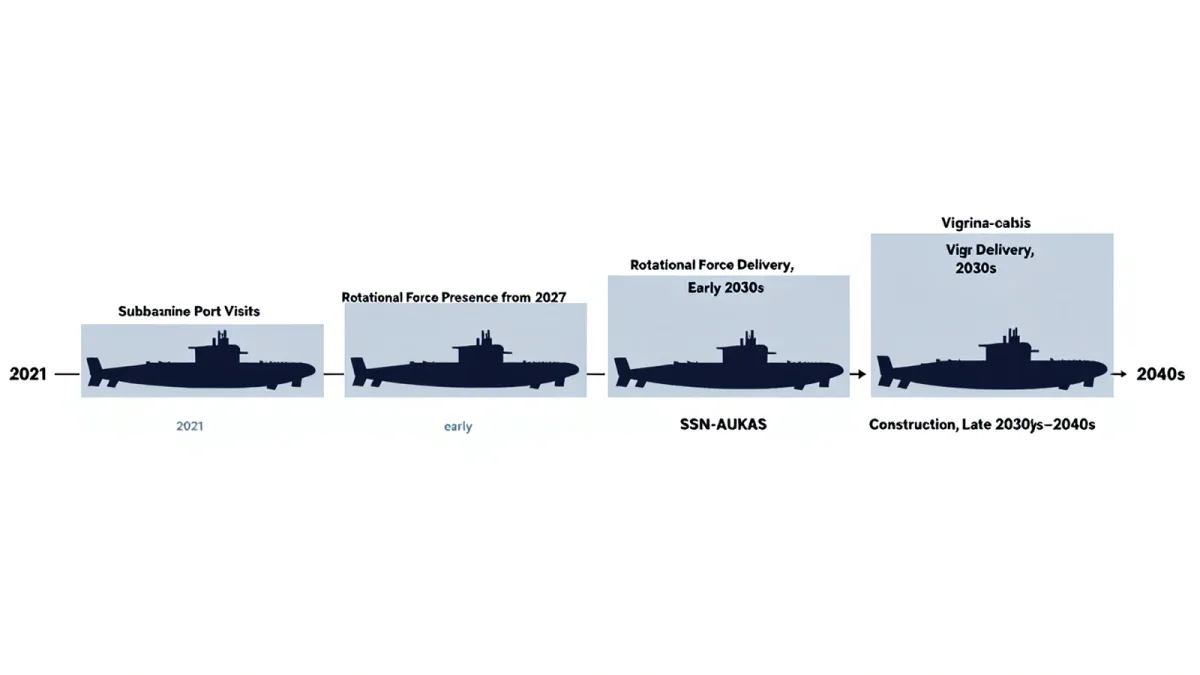
The San Diego statement described a phased sequence rather than a single delivery event. The stages, as announced on March 13, 2023, are the organizing structure for everything that follows.
- Phase 1: increased visits by US and UK nuclear-powered submarines to Australian ports, principally HMAS Stirling near Perth, beginning immediately and expanding over time.
- Phase 2: Submarine Rotational Force-West (SRF-West), under which US Virginia-class submarines begin a rotational presence at HMAS Stirling from 2027, with UK boats joining subsequently.
- Phase 3: Australian acquisition of three Virginia-class submarines, with an option for up to two additional boats, delivered in the early 2030s.
- Phase 4: construction and delivery of SSN-AUKUS, a new class based on a UK design incorporating US technology, with UK delivery in the late 2030s and Australian delivery in the early 2040s.
Which submarines does each country contribute?
The United States contributes Virginia-class attack submarines, the backbone of its own undersea force built by General Dynamics Electric Boat and Huntington Ingalls Industries' Newport News Shipbuilding. The United Kingdom contributes its Astute-class boats for early interoperability work and its SSN-AUKUS design, which builds on technologies already in UK service. Australia contributes infrastructure, personnel, and the future operator force itself. The San Diego statement and subsequent parliamentary testimony in all three capitals stressed that Pillar 1 does not transfer nuclear weapons: the submarines carry conventional weapons only, and nuclear material is accounted for under each nation's obligations as a nuclear-weapon state under the Treaty on the Non-Proliferation of Nuclear Weapons, with Australia remaining a non-nuclear-weapon state.
What US legislation made the Virginia sale possible?
Existing US law tightly restricts the export of naval nuclear propulsion technology, so Congress had to act. The fiscal year 2024 National Defense Authorization Act, signed into law in December 2023, authorized the sale of up to three Virginia-class submarines to Australia with an option for up to two additional boats, subject to conditions including certification that Australia can maintain and operate them responsibly. The same legislation addressed submarine export reform and directed reporting on US submarine industrial base capacity. Because Australia is the only country to receive Virginia-class exports, oversight committees in both chambers continue to track whether US production rates support the sale without degrading the US Navy's own attack submarine fleet.
What has been built so far?
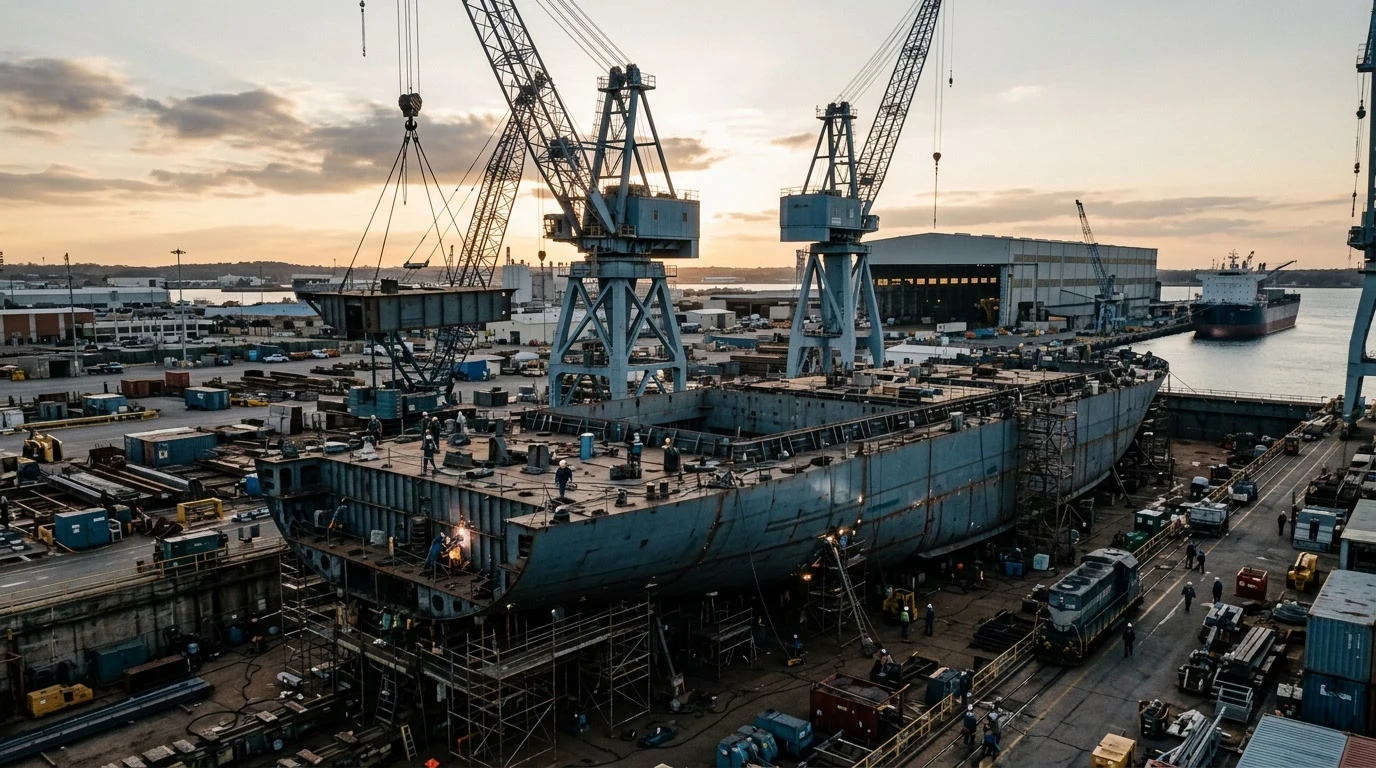
Progress through the mid-2020s has been institutional and industrial rather than hull-in-water. Australia legislated the Australian Nuclear-Powered Submarine Force in 2023, creating a statutory framework and an independent nuclear-powered submarine regulator. The Submarine Agency structure was established in the United States and the United Kingdom, and Australia stood up its own Submarine Agency in 2023. US and UK submarine rotations through HMAS Stirling increased under the capability-uptake pathway, and Australian sailors began training at US and UK submarine schools, including the US Navy's Nuclear Power School. Shipyard investment followed: commitments to expand capacity at Osborne in South Australia and at UK and US facilities were announced in connection with the Optimal Pathway. Readers should treat any hull-level delivery dates beyond those announced in March 2023 as unconfirmed until all three governments state them formally.
How is nuclear propulsion regulated in Australia?
Australia's 2023 legislation established the Australian Nuclear-Powered Submarine Safety and Regulator framework, created a statutory licensing regime for the reactors, and required parliamentary and international reporting. The three governments have also worked with the International Atomic Energy Agency on verification arrangements designed to ensure nuclear material used in naval reactors is not diverted, a negotiation the IAEA confirmed had begun in 2023. The arrangement is unusual because Australia is the first non-nuclear-weapon state to pursue nuclear-powered submarines, and the IAEA safeguards model for it does not copy any existing precedent.
What are the main risks and open questions?
Three constraints recur in official assessments. First, the US attack submarine force must sustain production of roughly the Virginia-class rates that both the US Navy and the Australian sale depend on; GAO and Navy industrial base reporting through 2024-2025 shows supplier workforce and material challenges. Second, Australia must recruit, train, and retain the nuclear-qualified operators and maintainers for a force that will not deliver its first owned boat for years. Third, cost: the Australian government's March 2023 figures placed the program between AUD 268 billion and 368 billion through the mid-2050s, a figure frequently cited in parliamentary debate. None of these questions has a settled public answer as of early 2026.
What is Pillar 2, and how does it differ?
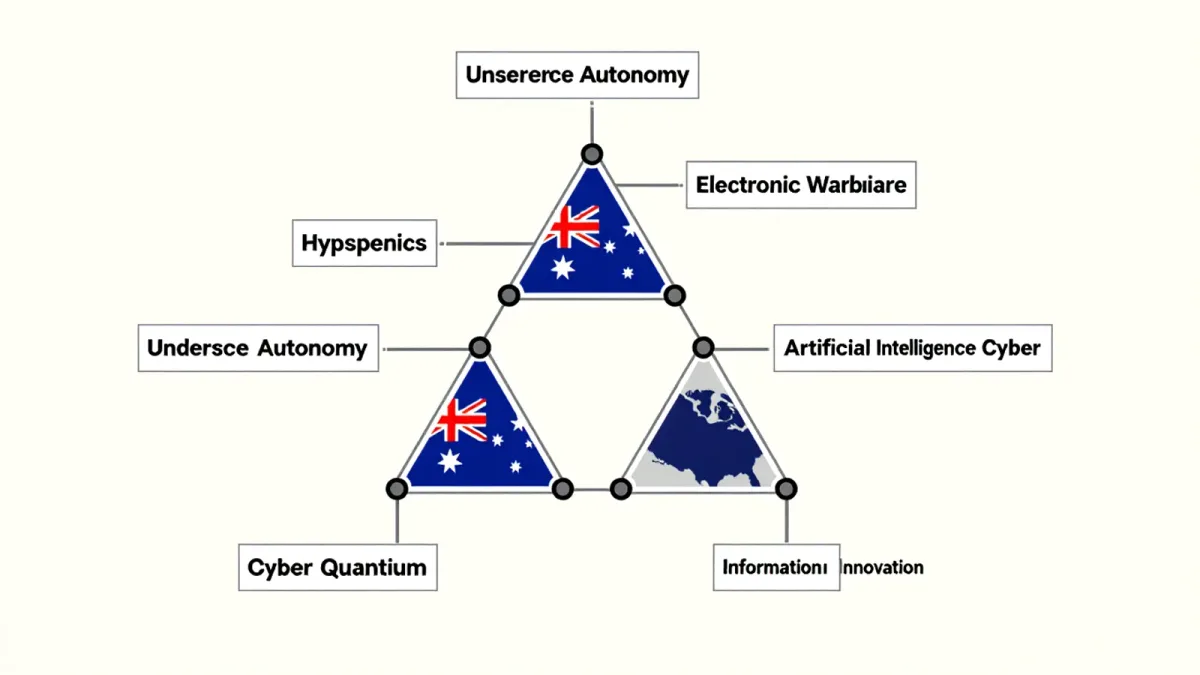
Pillar 2 covers advanced capabilities other than submarines: undersea systems, hypersonics and counter-hypersonics, electronic warfare, artificial intelligence, cyber, quantum technologies, and additional undersea autonomy work. Pillar 2 is open in practice to deeper participation and does not involve nuclear propulsion technology at all. When officials say AUKUS without specifying a pillar, the submarine program, Pillar 1, is usually what they mean.