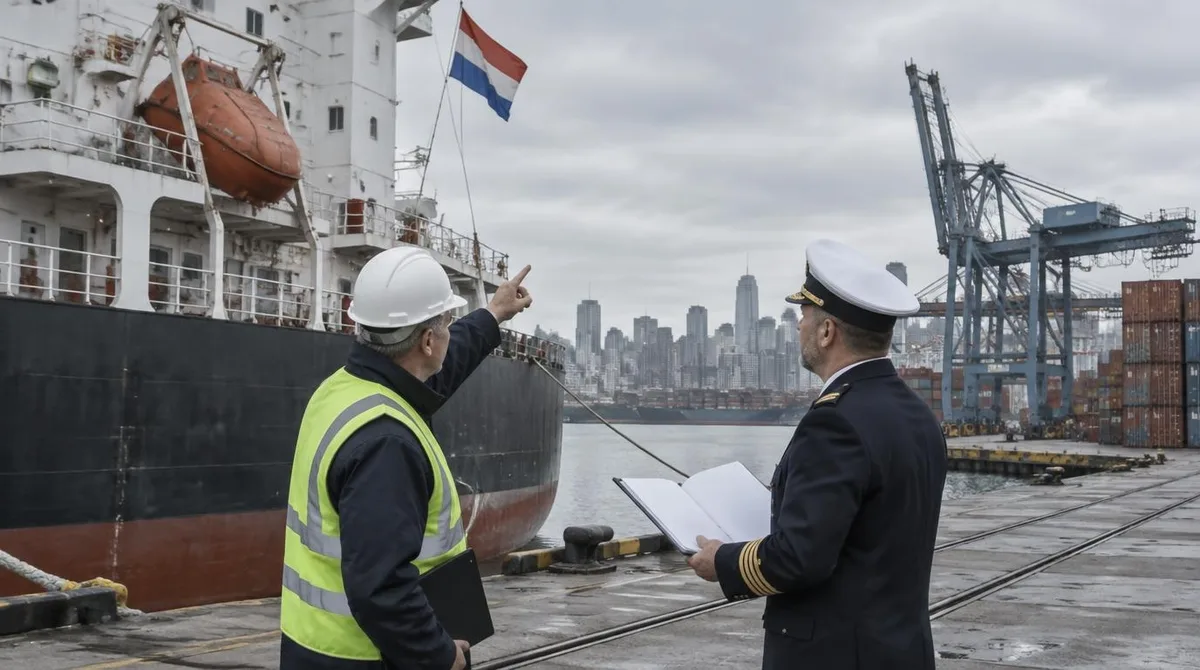
Flag state responsibility means every merchant ship answers to one country. That country is the state whose flag it flies. It writes the registry rules and surveys the hull. It checks the crew's papers and investigates casualties. International law assigns the duty. Port inspections exist because the duty is not always met.
The duty is written in treaty text. Article 94 of the United Nations Convention on the Law of the Sea sets the rule. The 1982 treaty is often called UNCLOS. It requires every state to "effectively exercise its jurisdiction and control" over ships flying its flag. The control covers administrative, technical, and social matters. The stakes are wide: as of 2025, more than half of the world's merchant tonnage sails under open registries. The guide to the Posse Comitatus Act and naval power marks another boundary of state authority; the policy section gathers more guides to law at sea.
What Does the Law Require of a Flag State?
The convention text is specific. A flag state keeps a register of its ships. It applies its internal law to each vessel, its master, officers, and crew. It takes the measures needed for safety at sea. Those measures cover construction, equipment, seaworthiness, manning, labour conditions, and crew training.
Article 94 goes further, according to the text published by the United Nations. Each ship must be surveyed by a qualified surveyor before registration and at proper intervals. Masters and officers must hold proper qualifications in seamanship, navigation, and engineering. Crews must match the ship's type, size, machinery, and equipment in skill and numbers. The state must also hold an inquiry into every high-seas casualty involving loss of life or serious damage. Article 91 adds that a genuine link must exist between the state and the ship. Article 92 allows one flag only.
Why Do Owners Register Ships Abroad?
Cost and convenience lead the list. An open registry imposes no nationality or residency requirement. Owners choose it to cut operating costs, avoid higher taxes, or employ cheaper foreign labour. As of 2025, such registers carry more than half of world merchant tonnage.
The practice is old. In the 1920s, owners serving alcohol during Prohibition registered ships in Panama. In 1968, Liberia overtook the United Kingdom as the world's largest ship register. Older maritime nations answered with second registers, starting with the Isle of Man in 1984. A 1986 United Nations convention tried to write the genuine link idea into binding rules.
How Is a Flag State Held to Account?
Performance varies. The International Maritime Organization reports that serious casualty rates differ enormously from flag to flag. The worst fleets run rates a hundred times worse than the best. A Sub-Committee on Flag State Implementation followed in 1992 to improve government performance.
The organization counts 167 member governments. It describes the problem bluntly: plenty of teeth, but some do not bite. Two tools respond. The Voluntary IMO Member State Audit Scheme helps states assess their own performance. The treaty adds another tool. A state with clear grounds may report a lapse. The flag state must then investigate and remedy the situation.
What Role Does Port State Control Play?
Port state control is the backup. The IMO conventions allow it. Governments may inspect foreign ships that visit their ports. The check covers IMO standards. A ship can be detained until repairs are carried out. The IMO reports the method works best through regional agreements. For related coverage, see Sealift and Merchant Marine Readiness: How America Moves a War Through Commercial Ships.
The trigger was a wreck. After the Amoco Cadiz sinking, fourteen European nations signed the 1982 Paris Memorandum of Understanding on Port State Control. Regional bodies now cover Europe, Asia and the Pacific, Latin America, and the Caribbean. Others span West Africa, the Black Sea, the Mediterranean, the Indian Ocean, and the Gulf. Tokyo MOU members ran 17,269 inspections in 2015 and logged 83,606 deficiencies, with 1,153 detentions.
Conclusion: One Flag, One Answer
The rule is easy to state and hard to police. A ship carries one nationality. Its state answers for surveys, crews, and casualties under Article 94. Reality shows the spread: casualty rates differ a hundredfold between the best and worst fleets. Open registries now carry most tonnage. Port inspections, audit schemes, and treaty reports form the safety net. The 2015 Tokyo numbers show it working ship by ship.