Ships retire in numbers that surprise people. A navy does not scrap every hull the day it leaves service. Many ships sail to a quiet anchorage, get sealed, and wait. Some never move again. Others wake up decades later and go back to work.
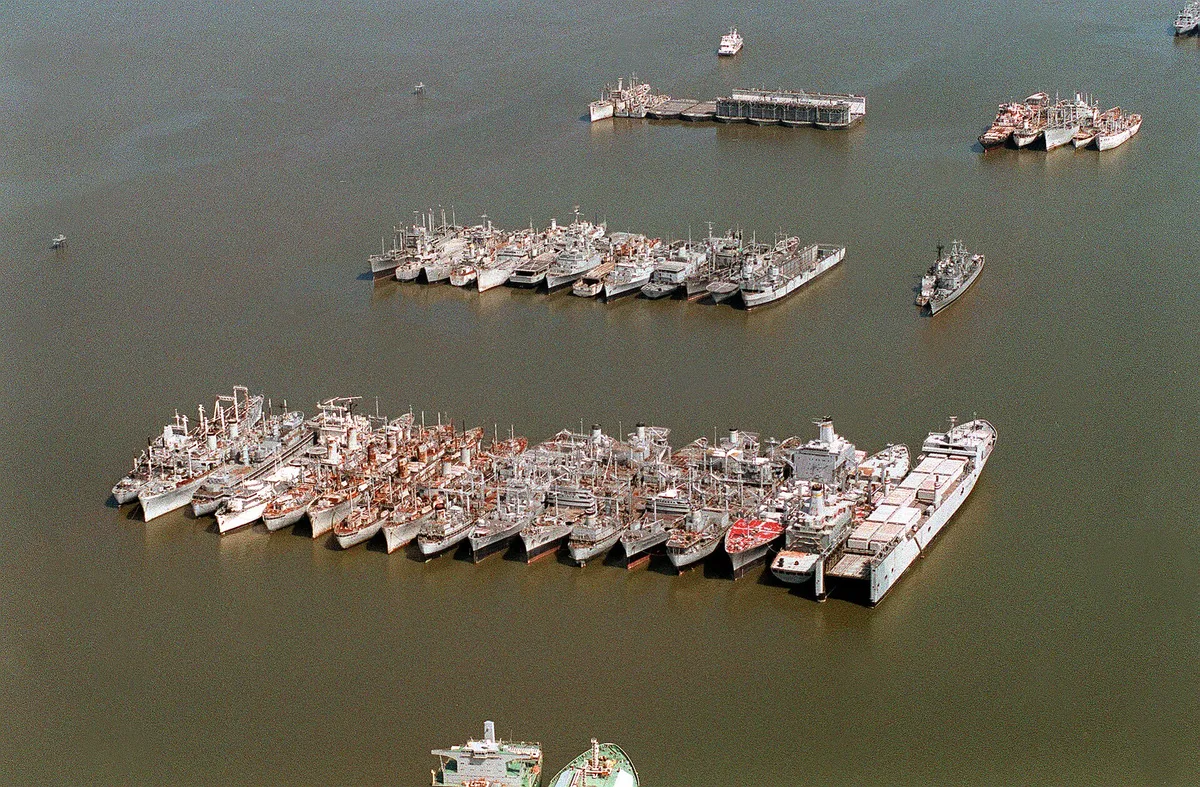
These anchorages are reserve fleets, and they are one of the strangest sights in maritime life: rows of gray hulls, tied together, silent, but officially kept alive.
What a Reserve Fleet Is
A reserve fleet is a group of mothballed ships held so they can be reactivated if the country needs them. The best-known American example is the National Defense Reserve Fleet, managed by the Maritime Administration. Its ships are mostly merchant vessels, and they can be activated within 20 to 120 days to provide shipping during national military emergencies or commercial shipping crises.
The Navy keeps its own reserve fleets as well, and those hold the naval vessels. The two systems are distinct: the Maritime Administration stores merchant shipping, while the Navy stores warships and auxiliaries.
Where the Ships Sit
Reserve fleets need calm, protected water. The main NDRF sites are the James River in Virginia, Beaumont in Texas, and Suisun Bay in California, with some ships at designated outport berths. Former anchorage sites included the Hudson River in New York, Wilmington in North Carolina, Mobile in Alabama, Astoria in Oregon, and Olympia in Washington.
Suisun Bay may be the most photographed. Its rows of pale hulls sit within sight of San Francisco Bay traffic, a ghost fleet in plain view of commuters. For related coverage, see The Littoral Combat Ship Fleet in 2026: How Many Hulls Remain and Why.
Why Fleets Shrink Over Time
The reserve was built for a larger world. The NDRF was established under Section 11 of the Merchant Ship Sales Act of 1946, and at its peak in 1950 it held 2,277 ships in lay-up. By 2003 the number was 274. In December 2021 it was down to 91. Through the 2010s, the oldest hulls at Suisun Bay were stripped of toxic materials and broken up, with dozens of the most polluting mothball ships recycled by 2017.
Shrinking is not decay in the strategic sense. Merchant hulls from the 1940s simply lost their value as newer tonnage entered the reserve, and preservation money follows the ships worth keeping.
When Mothballs Come Off
Reserve ships have gone to work many times. During the Korean War, 540 vessels were broken out to move military forces. In a worldwide tonnage shortfall in 1951 to 1953, more than 600 ships reactivated to carry coal to Northern Europe and grain to India. When the Suez Canal closed in 1956, 223 cargo ships and 29 tankers came out of reserve. During the Berlin Crisis of 1961, 18 vessels activated, and 172 more sailed for the Vietnam War. This connects to our earlier piece, How Many Ships Does the U.S. Navy Have? The Battle Force Count Explained.
In 1976, a Ready Reserve Force was established as a subset of the NDRF for rapid deployment of military equipment. Those ships, now numbering 72, are kept ready for activation within four to twenty days, far faster than the standard reserve.
Conclusion: An Insurance Policy Made of Steel
A reserve fleet is insurance. Nobody hopes to use it, and keeping it costs money every year, but the moment a war or a shipping crisis cuts normal supply, mothballed hulls become the difference between shortfall and coverage. Most retired ships still end up scrapped. The ones that wait in reserve exist for the day when waiting pays off.