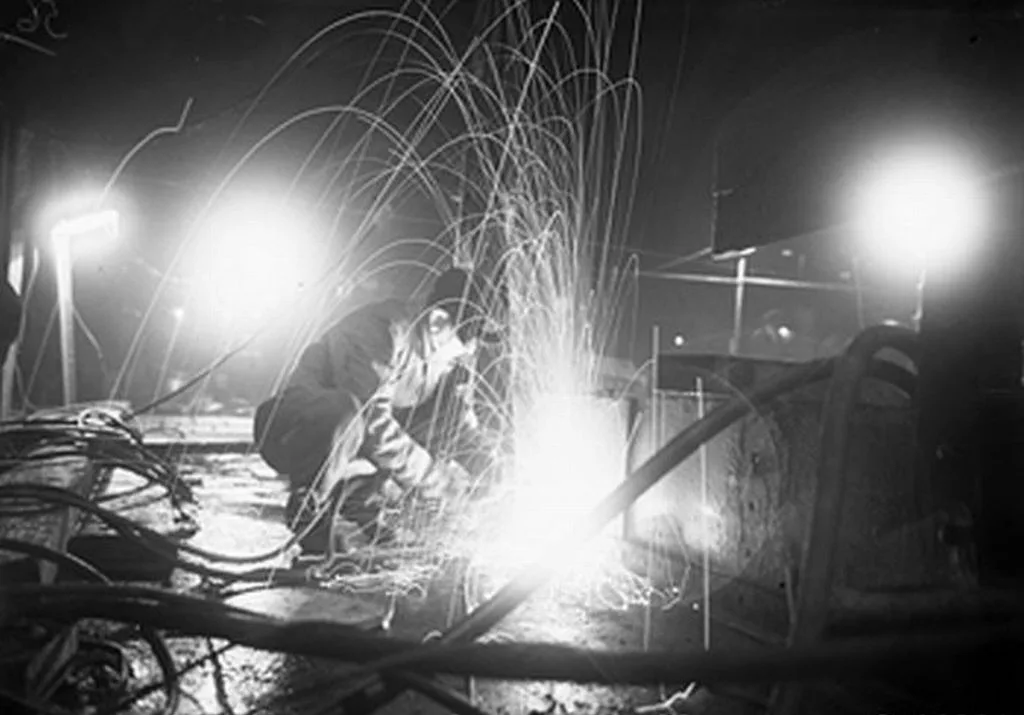
A welded hull is a single continuous structure made of thousands of individual seams. Each weld carries structural load, keeps seawater out, and is inspected before the next stage of construction proceeds. A single defective seam can propagate a crack under wave loading, which is why classification societies and navies treat welding as a controlled process rather than a routine trade task.
This guide explains how welding fits into modern ship construction, who sets the standards, how welds are inspected, and why weld quality sits near the center of the shipbuilding industrial-base debate. It draws on published process descriptions, industry reference material, and the August 2026 presidential memorandum on the shipbuilding industrial base.
Where does welding fit in the shipbuilding process?
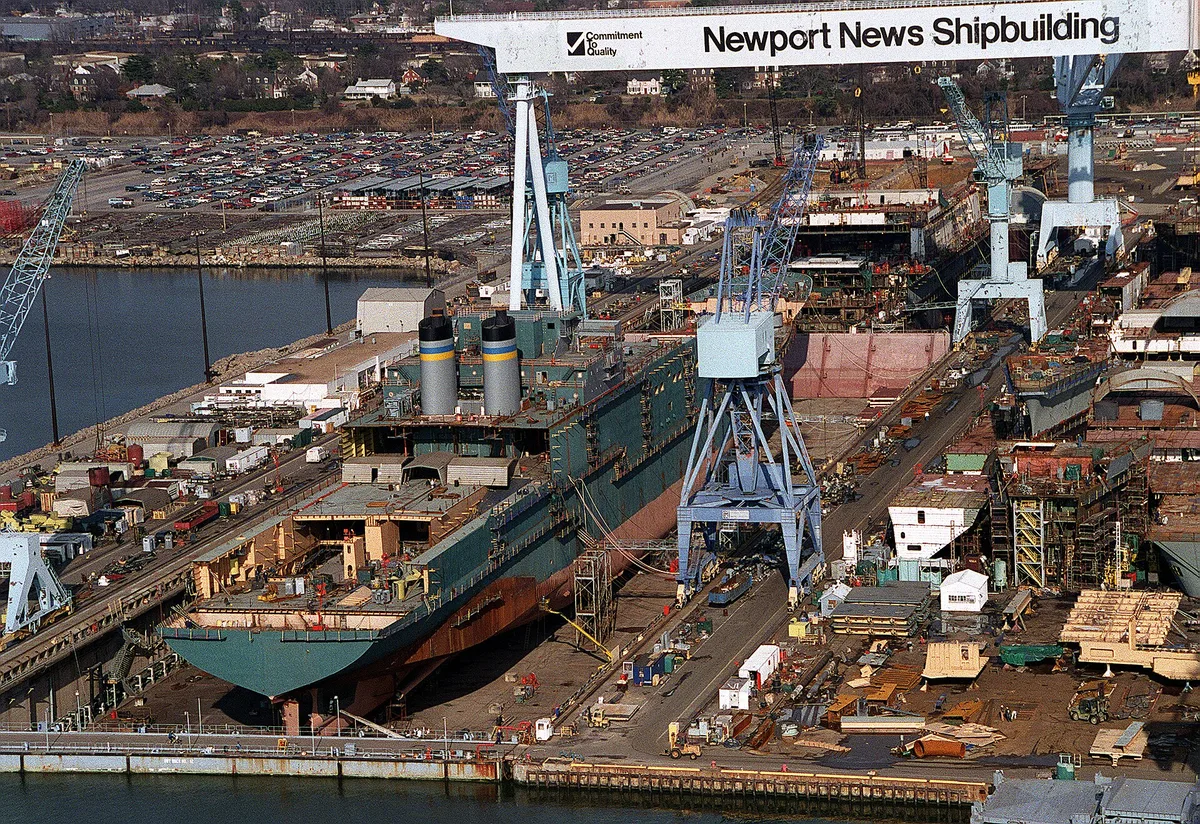
Welding appears at nearly every production stage after steel arrives at the yard. Steel plates are cut and bent to the required dimensions, then joined by welding into larger panels. As Maritime Page describes in its overview of the shipbuilding process, panel fabrication is the stage where several plates are welded together to meet the required dimensions, before those panels are assembled into blocks and eventually into the hull on the building berth.
The sequence matters. A weld made early, in a flat panel shop under good conditions, is easier to control than a weld made later, deep inside an assembled module. Shipyards therefore push as much welding as possible into the shop, where panels lie flat and access is simple. The amount of welding done in awkward positions inside a completed block is a rough indicator of how well a yard's production planning works.
The same logic applies at fleet scale. Britannica's entry on ship construction notes that the launching berth is now an assembly area rather than a construction site, with prefabrication sheds doing more of the work. Greater ease of fabrication means more ships can be built and construction costs lowered, even as the number of launching berths shrinks.
Why are hull welds so critical to a ship's structure?
A steel hull works as a continuous girder. The plates and frames resist loads from waves, cargo, and machinery, and the welds are what make those separate pieces behave as one structure. Britannica describes how detailed scantlings, the frame dimensions and plate thicknesses, are obtained from the rules of the classification society, and those scantlings determine the requisite weight of hull steel. A weld that is undersized, porous, or cracked does not deliver the strength those scantlings assume.
The loads are not gentle. As Maritime Page notes, hull and deck structures are designed against loads including slamming into waves during operations, with finite element analysis used to model close-to-real outputs for structural design. A hull seam therefore sees repeated cyclic stress over a service life measured in decades. Fatigue cracks in steel structures tend to start at discontinuities, and a weld is the most common discontinuity in a hull.
Welds also seal. Below the waterline, a failed seam is a flooding risk, not just a strength deficiency. Passenger vessels must satisfy bulkhead subdivision standards so the hull remains stable if it is pierced accidentally, as through collision, Britannica notes. Every watertight boundary in that subdivision scheme depends on weld integrity.
What standards govern shipbuilding welding?
Welding in commercial shipbuilding is governed by classification society rules. Classification societies are independent bodies that set structural and construction rules, verify compliance during the build, and issue certificates a vessel needs to trade. Their rules cover welder qualification, welding procedure approval, materials, and the extent of inspection at each stage.
Naval construction adds government standards on top. A navy specifies its own weld processes, inspection requirements, and acceptance criteria for warship hulls, and its own surveyors witness the work. The practical effect is that a naval hull weld is documented from the welder's qualification record through the final inspection report, seam by seam.
The labor side is part of the standard. Britannica's description of the shipyard labor force lists steelworkers and welders among the core trades, alongside shipwrights, joiners, plumbers, turners, engine fitters, electricians, riggers, and painters. A welder's qualification is specific to the process, position, and material, so staffing a naval program requires a certified workforce, not just headcount. Naval Pages covers the trade structure in its Shipbuilding Jobs Guide: Trades, Apprenticeships and Career Ladders. We covered a connected angle in Shipbuilding Jobs Guide: Trades, Apprenticeships and Career Ladders.
How are hull welds inspected?
Inspection happens during construction, not only at the end. The typical sequence runs:
- Fit-up check. The joint geometry, alignment, and cleanliness are checked before any arc is struck.
- In-process control. Weld parameters, such as heat input and travel speed, are monitored against the approved procedure.
- Visual inspection. The completed weld is examined for surface defects such as undercut, porosity, and cracks.
- Non-destructive testing. Methods such as ultrasonic testing, radiography, and dye penetrant examination check the weld's interior without damaging it.
- Documentation and sign-off. Results are recorded and witnessed by the classification society or navy surveyor before later stages close over the weld.
Access drives the schedule. Once a compartment is closed out, painted, and outfitted, re-inspecting a weld inside it becomes far more expensive. This is why inspection is sequenced into the build plan, and why a weld defect discovered late can ripple into schedule slip. Naval Pages explains how late-stage discoveries compound into delay in The Navy's Repair Backlog: How Ship Availabilities Work and Why They Fall Behind. For related coverage, see The Navy's Repair Backlog: How Ship Availabilities Work and Why They Fall Behind.
What happens when a hull weld fails?
A weld defect does not automatically become a casualty. The risk depends on the defect type, its location, and the loads at that point. Small surface defects in low-stress regions may be acceptable under the applicable rules. Cracks, or defects in high-stress regions such as the keel, the strength deck, or the connections of major transverse structures, are treated far more seriously.
When a defect is found, the standard remedy is to remove the defective weld metal, usually by grinding or gouging, and re-weld under the approved procedure, then re-inspect. On a new build, this costs time. In service, it costs availability. A hull weld repair discovered during a maintenance period competes for the same dock time and workforce as every other job, which is one reason repair availabilities run over.
The systemic risk is workforce-related rather than technical. Welding skill is perishable and takes years to build. The 2026 presidential memorandum on rebuilding the United States Navy and America's shipbuilding industrial base describes an atrophied industrial base with diminished adjacent supplier bases, expanded delays, and increased costs across major Navy shipbuilding programs. A certified welding workforce is part of that base, and it cannot be expanded quickly.
How is technology changing shipyard welding?
Automation is moving into the welding shop. As Shipfinex notes in its 2026 industry overview, robots now handle welding and painting in shipyards, and digitalization is transforming design and supply chain management. Automated panel-line welding suits the flat, repetitive work where most hull welds are made, and it produces consistent parameters that simplify inspection.
The limits are positional. Robots excel at flat panel welding and struggle with the confined, irregular welds inside an assembled module. Human welders remain essential for those joints, which keeps welder certification and retention at the center of yard performance.
What this means for fleet programs is straightforward. Welding capacity is a constraint on delivery, not a detail. A yard that cannot produce and inspect qualified welds at rate cannot deliver ships at rate, whatever the contract schedule says. Naval Pages follows the capacity question in its guide to shipbuilding programs and in Submarine Industrial Base Investment: Where the Money Goes and What It Buys.
What remains uncertain about weld quality and shipbuilding capacity?
The technical standards for hull welding are stable and public, through classification society rules and government specifications. What is not publicly quantified, yard by yard, is the current stock of certified welders, the inspection throughput available, and the rate at which weld-related rework contributes to schedule slip in specific programs. Those figures live in contractor and government program data that is not routinely released.
The evidence that is public points one way. The 2026 memorandum attributes Navy shipbuilding setbacks to overly complex designs, cost growth, delays, and capacity shortfalls, and directs the Department of War to restore capacity and competition using proven, reliable, and affordable technologies. Welding sits inside that directive twice over: as a production process that must be performed at rate, and as a skilled trade the expanded workforce must be trained to perform. Readers tracking program delivery should watch welder workforce numbers and inspection capacity as leading indicators, because they move years before delivery dates do.