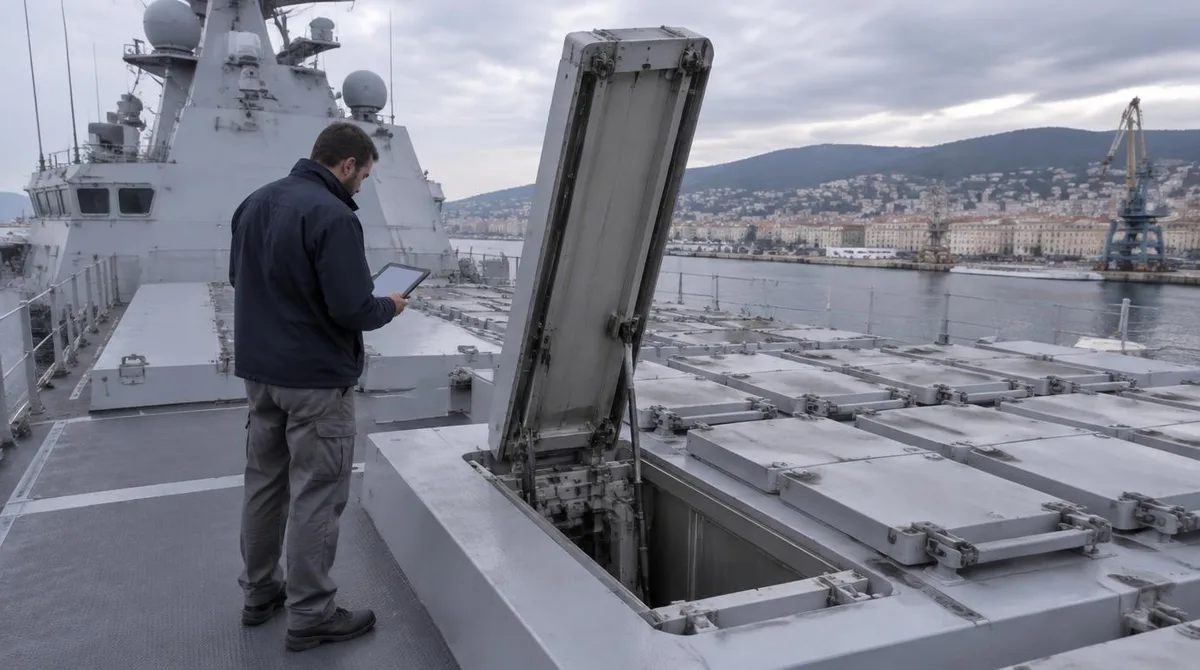
Italy has confirmed, in its 2026–2028 Multi-Year Defence Programming Document, that it will develop a national vertical launching system (VLS) for its future fleet. The launcher is planned for the Next Generation Destroyers (NG DDG, also known as DDX) first, then for FREMM Evo frigates, and it will fire both surface-to-surface and surface-to-air missiles, according to Naval News in a November 2026 report.
The decision matters because a VLS is the armament backbone of a surface combatant. It decides which missiles a ship can carry and how they are mixed. By building its own launcher, Italy gains control over that backbone for its two next surface programs, rather than relying on a foreign or specialized design. The plan also ties the launcher to two future munitions: the Stratus LO deep-strike cruise missile and the Aquila interceptor. This connects to our earlier piece, The Tomahawk Cruise Missile Explained: Variants, Launchers, and the Block V Era.
The industrial route is already visible. Development work is expected to be assigned to MBDA Italia as design authority, providing its firing unit, with support from Fincantieri, and a multi-stage contract is foreseen in the coming months. Naval architects are meanwhile designing the destroyers on a "fit and form" basis, so the hulls can receive the system once development concludes.
Why does Italy want its own launcher?
The stated driver is a missile, not a launcher. Naval News reports, from sources with knowledge of the matter, that a primary driver is the requirement to deploy Stratus LO, a low-observable deep-strike cruise missile developed under a trinational partnership between France, Italy, and the United Kingdom, led by MBDA. Rome plans to join the next development and qualification phase, with that contract expected to be awarded by early 2027.
A sovereign launcher also removes a dependency question that would otherwise sit at the center of two major ship programs. If the deep-strike missile and the air-defense missiles of the future fleet all come from European industry, a national launcher keeps the interface between ship and missile under national control as well.
What problem does it fix with the current launcher?
Italian surface combatants today carry the French SYLVER VLS family. According to Naval News, SYLVER variants are specialized rather than truly multi-ammunition: the A50 cell version handles air-defense Aster missiles, while the deeper A70 handles MdCN land-attack cruise missiles. A single module cannot mix offensive and defensive loads.
That is an operational limitation. A ship with fixed cell types must plan its magazine around the launcher's divisions, not around the mission. The new Italian system is designed as a multi-missile launcher, so one installation could in principle host both strike and air-defense rounds. Naval News contrasts this with flexible launchers such as the U.S. Mk 41, which already allow mixed loads.
The move is not unique in Europe. Naval News learned from DGA and French Navy sources at Euronaval 2026 that France is working on its own next-generation launcher, SYLVER NG, which will be multi-ammunition capable, with a first prototype expected to be tested by 2030. Italy and France are therefore converging on the same design answer from different starting points. For related coverage, see Virginia-Class Attack Submarines: The Navy's Fast-Attack Fleet, As of 2026.
Which missiles will the new VLS fire?
The launcher is planned to accommodate MBDA's existing Aster surface-to-air missile family, including the Aster Block 1NT, while paving the way for the future Aquila interceptor. Aquila is being developed under the European HYDIS² (Hypersonic Defence Interceptor System) initiative and is competing to become Europe's premier endo-atmospheric interceptor, capable of neutralizing both ballistic and hypersonic threats.
That pairing gives the launcher a long service runway. Aster covers today's air-defense requirement. Aquila, if it reaches service, would cover a threat category — hypersonic weapons — that current interceptors were not designed against. A launcher confirmed now, for hulls still on the drawing board, is built to outlast several missile generations.
What does this mean for the fleet?
The first two platforms are currently planned to carry four A50 VLSs each, Naval News understands, with the national launcher to follow. That detail shows how the transition is meant to work: the NG DDGs and FREMM Evo are designed to accept the new system without redesign, and the launcher slots in once it is ready.
The analysis behind the plan is straightforward. Coupling a sovereign launcher with national and European munitions — Stratus LO for deep strike, Aster and Aquila for tiered fleet air defense — aims to future-proof Italian surface combatants for high-intensity naval warfare while adding loadout flexibility. What remains unknown is the timeline for the launcher itself and the multi-stage contract's value; the programming document confirms the intent, and the contract award in the coming months will show how the commitment is funded and phased.